
Mongolia’s high reliance on imported food products
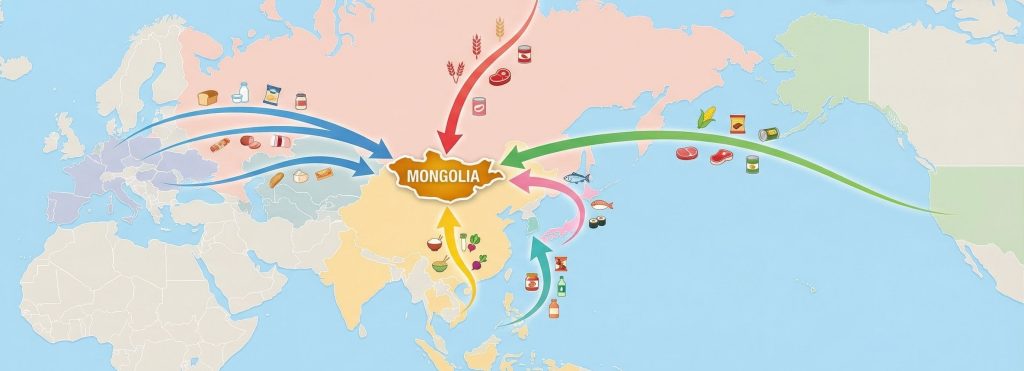
Mongolia is a vast country with a harsh climate and challenging agricultural conditions, which significantly limits the cultivation of many plant-based crops. Beyond its well-developed livestock sector (supplying mainly meat and dairy products), the country has long relied on imports for a substantial share of its food supply. In 2024, among the main categories of imported products, food products ranked 5th overall, highlighting the structural role that imports play in Mongolia’s domestic supply.
|
Imported commodity groups
|
Value (in thousands of USD)
|
|---|---|
|
Machinery, equipment, electric appliances, recorders, TV, sets and spare parts
|
2 523 017,26
|
|
Mineral products
|
2 444 579,63
|
|
Auto, air & water transport vehicles and their spare parts
|
2 432 178,62
|
|
Base metals & articles thereof
|
959 216,88
|
|
Food products
|
864 444,33
|
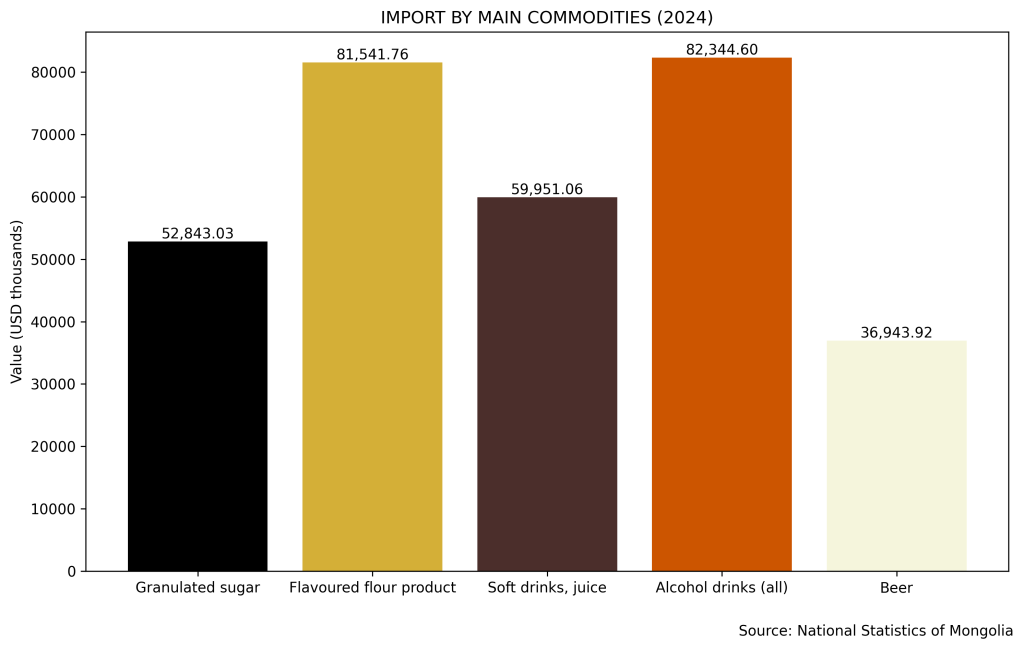
More specifically, within imported food products, flavoured flour-based products ranked second by total import value, reaching about USD 81.5 million, behind alcoholic beverages. This indicates both a significant share of food imports and strong demand for processed flour/grain-based products in the Mongolian market.
Imported food is shifting from a “niche premium” offering to being widely available in mainstream retail channels
Beyond meeting basic needs such as staple foods and fruits and vegetables, the growing presence of imported foods has also expanded consumer choice.
➣ Premium supermarket: Good Price
Good Price positions itself as a retailer specializing in imported Western products. Its stores are concentrated in high-spending districts of the capital and target a premium clientele. The assortment includes many European and American imported brands, such as the U.S. brand Kirkland, the U.K. brand Walkers, Germany’s EDEKA, and Swiss chocolate brand Lindt.
➣ Long-established local retailer: Nomin
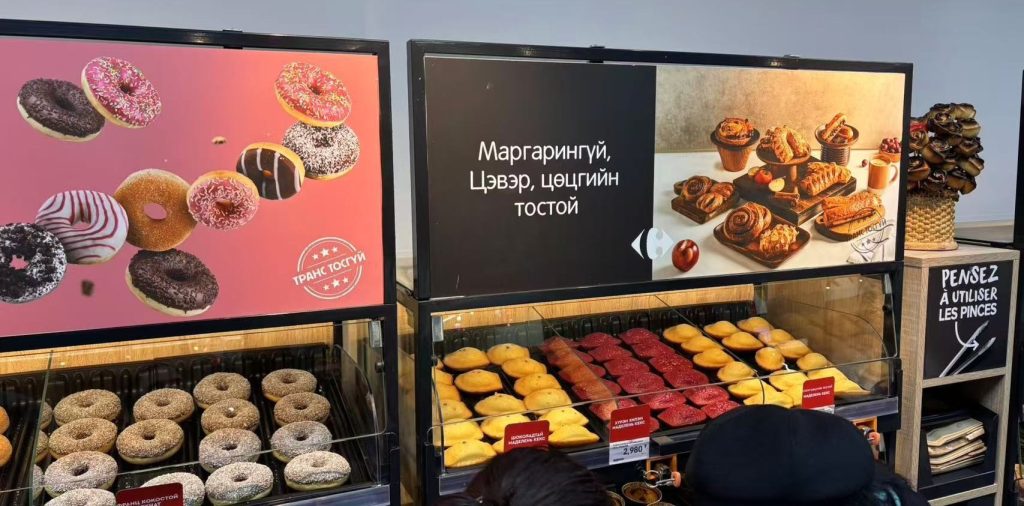
Nomin has the largest store network in the country, with 34 stores (22 supermarkets and 12 hypermarkets), and has branches both in the capital and in cities outside Ulaanbaatar. It also carries a wide range of European imported brands, such as French dairy brand Président, Italian pasta brand Barilla, and German biscuit brand Leibniz. This suggests that European imports are no longer limited to niche premium channels, they are increasingly visible in mainstream retail chains as well.
Why shelf-stable and frozen products are well suited to the Mongolian market
For exporters, shelf-stable products such as biscuits and packaged bakery items may be particularly suitable for the Mongolian market. As a landlocked country located between China and Russia, Mongolia relies heavily on long-distance transport routes for imported goods.
In practice, shipments from Western Europe can involve multi-country consolidation routes (e.g. Portugal, France, Belgium) before continuing overland through Eastern Europe and Russia, with total transit times of around 30 days. For frozen products, this requires strict temperature control at every stage, including during loading and unloading operations. In parallel, customs procedures can be highly demanding – particularly at Russian borders, where missing documentation may block the entire shipment.
But frozen dessert products present interesting opportunities, particularly within the foodservice sector. This is especially evident in Ulaanbaatar’s growing café culture. Several international coffee chains have established a strong presence in the Mongolian market, including South Korean brands such as Caffé Bene (around 40 outlets) and TOM N TOMS Coffee (about 32 outlets), as well as newer entrants like Mega MGC Coffee, which opened its first Mongolian locations in 2024. These chains typically offer a wide range of beverages alongside cakes, pastries, and other sweet snacks, illustrating the increasing urban demand for dessert products and highlighting opportunities for imported frozen items.
Legal requirements for importing food into Mongolia
According to Article 11 of Mongolia’s Law on Food, several regulatory requirements apply to companies importing food products into the country. First, food imports can only be conducted by legal entities registered in Mongolia, meaning foreign exporters must work with a local importer or distributor.
Importers must also comply with a number of conditions related to product traceability, safety, and logistics. These include having a direct trade contract with the manufacturer or its authorized distributor, ensuring that the imported food is produced in facilities that follow recognized food safety management practices, and guaranteeing that at least two-thirds (75%) of the product’s shelf life remains at the time of arrival. This requirement favors shelf-stable products such as biscuits and packaged snacks, which generally have longer shelf lives and are easier to distribute in Mongolia’s import-dependent market.
Certain products – such as food additives, enrichment preparations, or food derived from genetically modified organisms – must be properly registered before they can be imported into Mongolia. Importers must also ensure full compliance with traceability, safety, and cold-chain requirements, either through their own infrastructure or certified logistics partners.
Turning market insights into opportunities in Mongolia
As Mongolia’s retail sector expands and consumer exposure to international food products continues to grow, demand for imported snacks and dessert products is likely to remain strong. For European brands, products combining quality, strong branding, and logistical adaptability may find promising opportunities in the Mongolian market.
However, understanding a market like Mongolia requires more than looking at import statistics alone. Logistics constraints, regulatory frameworks, and local retail structures all play a role in determining how imported products successfully reach consumers. Identifying the right local partners and adapting to the country’s distribution realities are often key factors for successful market entry.
At Gourmet Selection, we closely follow these developments across Asia, helping European producers better understand emerging opportunities and connect with the right partners in evolving markets. We have already supported successful exports of European dessert products into Mongolia, giving us hands-on experience navigating the logistical and regulatory complexities of this market.
Sources
Good Price Market. https://goodpricemarket.mn/
National Statistics Office of Mongolia. (2024). https://www.1212.mn/en/statcate
Nomin. НОМИН Холдинг. https://www.nomin.co/en
Эрх зүйн мэдээллийн нэгдсэн систем. (2012). ХҮНСНИЙ ТУХАЙ. https://legalinfo.mn/en/edtl/16760186664561


