
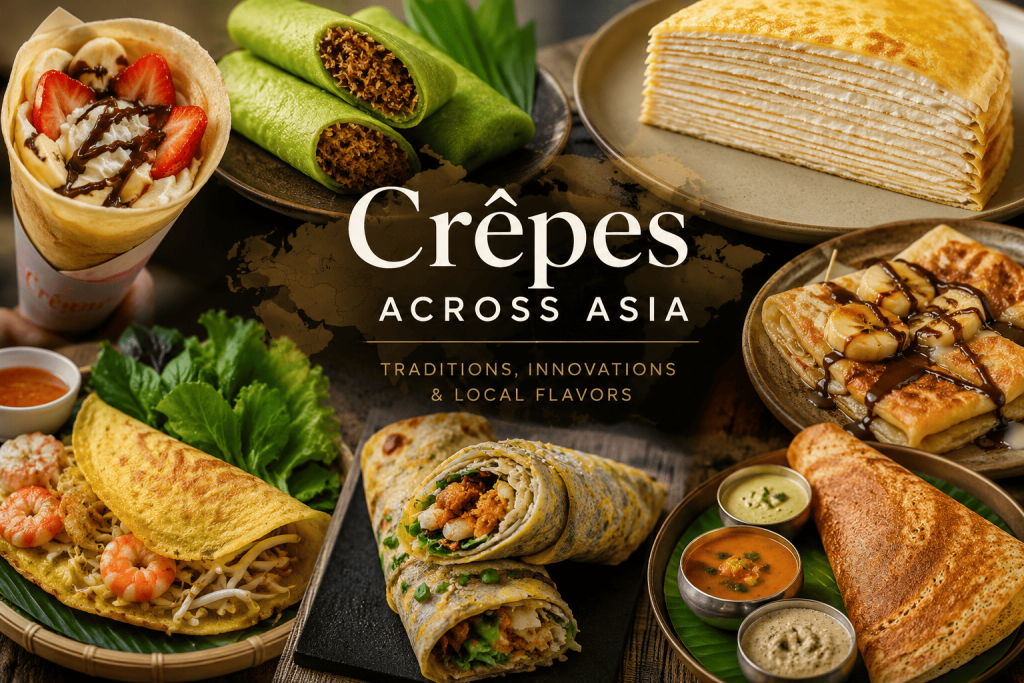
Brittany: the hometown of French crêpes
When people think of French crêpes, the image that most often comes to mind is usually rooted in Brittany, in the northwest of France. Known for its strong culinary identity and rich agri-food heritage, the region remains closely associated with crêpe culture today and is home to several specialized producers, such as Crêperie Lebreton and Le Monde des Crêpes.Traditional Breton crêpes
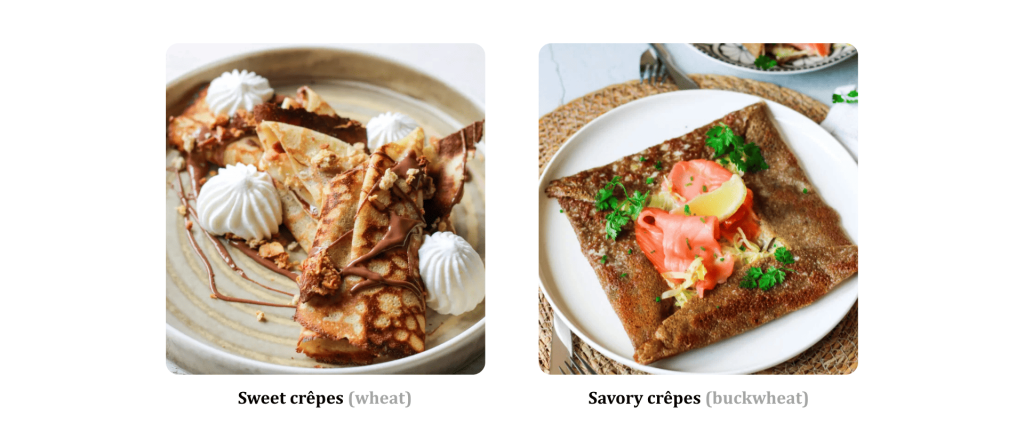
The history of Breton crêpes is closely linked to buckwheat, which was actually introduced to Europe from Asia around the 13th century and gradually became widely cultivated in Brittany thanks to the region’s humid and temperate climate.
Over time, several regional variations emerged. In Lower Brittany, both wheat-flour sweet crêpes and buckwheat crêpes became common, while Upper Brittany became particularly associated with galettes, a crispier version of the buckwheat crêpe, traditionally served with ingredients such as ham, egg, and cheese. Although the different styles may appear similar, variations in flour composition, the use of milk or eggs, and cooking techniques create distinct textures ranging from soft and flexible to thinner and more brittle.
Whether sweet or savory, Breton crêpes are traditionally enjoyed with Breton cider, reflecting the region’s strong culinary identity. Crêpes also hold an important cultural place in France through La Chandeleur (Candlemas), celebrated every year on February 2nd, when preparing and sharing crêpes remains a long-standing national tradition.
Crêpe dentelle
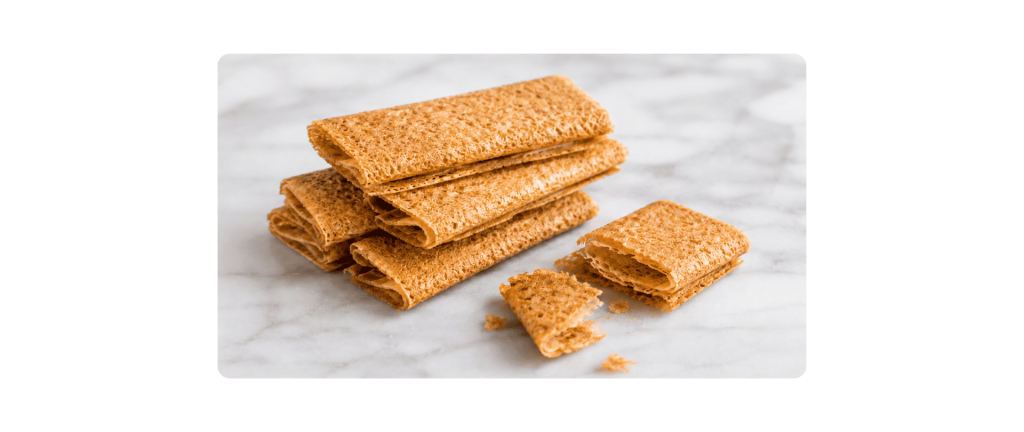
Crêpe dentelle was born from a beautiful accident. In Quimper in 1886, Marie-Catherine Cornic, a crêpe maker, left a crêpe on the billig (a traditional Breton griddle) for too long. Instead of throwing it away, she decided to roll it up into delicate layers, transforming it into a light, crisp biscuit with a texture as fine and intricate as lace.
Later, in the 1920s, a Breton biscuit manufacturer gave this creation the name “Gavottes”. The name paid tribute to a traditional Breton dance in eight beats, as the crêpe dentelle, folded into eight layers, was said to resemble this rhythmic pattern. Over time, Gavottes also became the most iconic commercial name associated with crêpe dentelle, helping popularize it in France and abroad.
While crêpe dentelle remains a finished biscuit in its own right, crushed versions derived from it have also become highly valued in modern pastry for the delicate texture they bring to desserts.
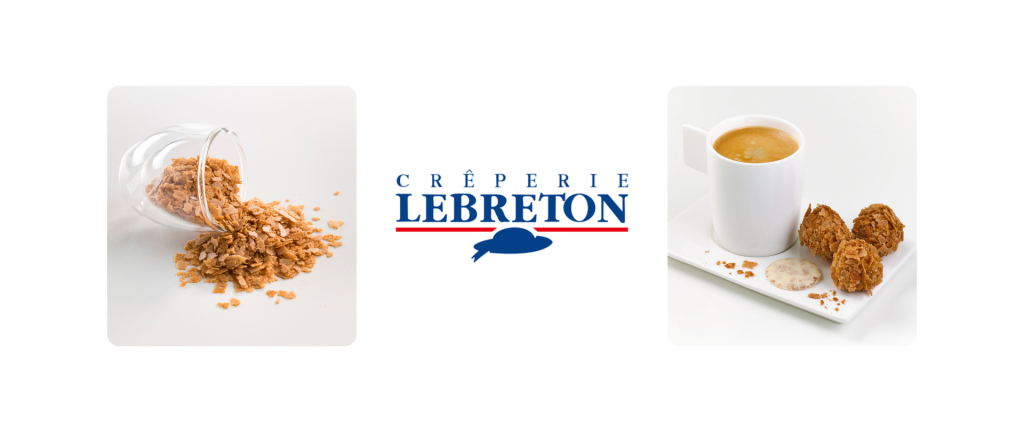
Made from crushed crêpe dentelle, crispy crêpe flakes are one of the most refined crunchy elements used in French pastry. Their delicate, flaky texture brings a light buttery crispness to desserts, creating an elegant contrast with smooth creams, mousses, praline fillings, and chocolate preparations.
As a specialist in high-quality crispy crêpe flakes, Crêperie Lebreton has also developed a dedicated recipe booklet showcasing the versatility of its products across many different applications. From pastry and viennoiserie to ice cream, confectionery, plated desserts, and Asian-inspired creations, these delicate flakes can be incorporated into crunchy layers, pressed biscuit bases, textured fillings, coatings, or inclusions. The recipes explore a wide variety of flavor combinations involving ingredients such as black sesame, coconut, pistachio, mango, dates, spices, and chocolate, illustrating how this traditional Breton product can adapt to both classic French pastry and more contemporary international dessert concepts.
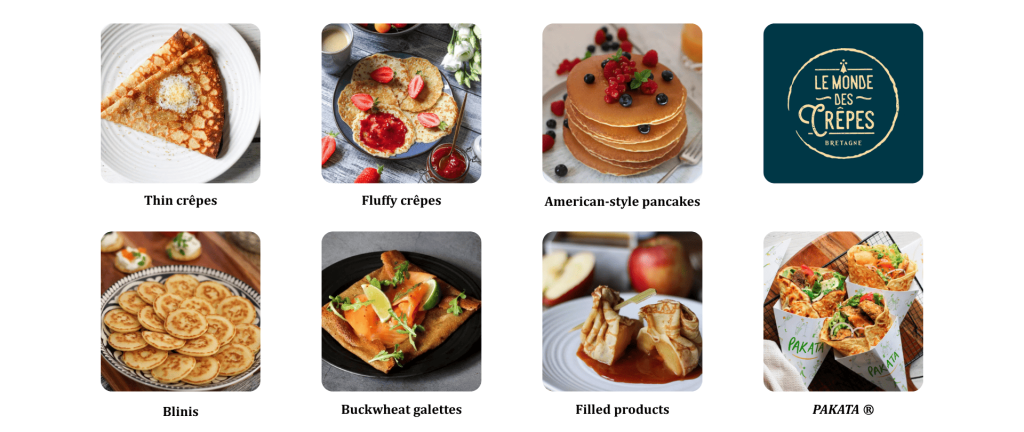
After exploring traditional Breton crêpes and pastry applications, it is also worth looking at brands that have adapted crêpes to modern foodservice needs. Breton company Le Monde des Crêpes specializes in frozen crêpes and related products designed for convenience, consistency, and versatility across a wide range of foodservice applications.
One of the brand’s key strengths lies in its ability to combine practicality with traditional know-how. Its frozen formats are designed to be easy to store, quick to prepare, and simple to integrate into professional kitchens, while still emphasizing quality local ingredients and recipes made without added preservatives.
The product range covers many different formats and usages, including thin crêpes, fluffy crêpes, pancakes, blinis, and buckwheat galettes, suitable for breakfast, snacks, desserts, and savory dishes alike. In addition to these classic products, the company has also developed several ready-to-use filled formats and more innovative concepts such as PAKATA®, an egg-rich crêpe designed to be easy to fill, fold, and eat. Combining practicality, lightness, and flexibility, it reflects how traditional Breton products continue to evolve alongside contemporary foodservice and fast-casual consumption trends.
Exploring sweet crêpes across Asia
Looking beyond Brittany, the APAC region reveals a remarkably diverse landscape of crêpe-like products and batter-based specialties. From street food to premium desserts, these local interpretations reflect very different cultural influences, textures, and consumption occasions.
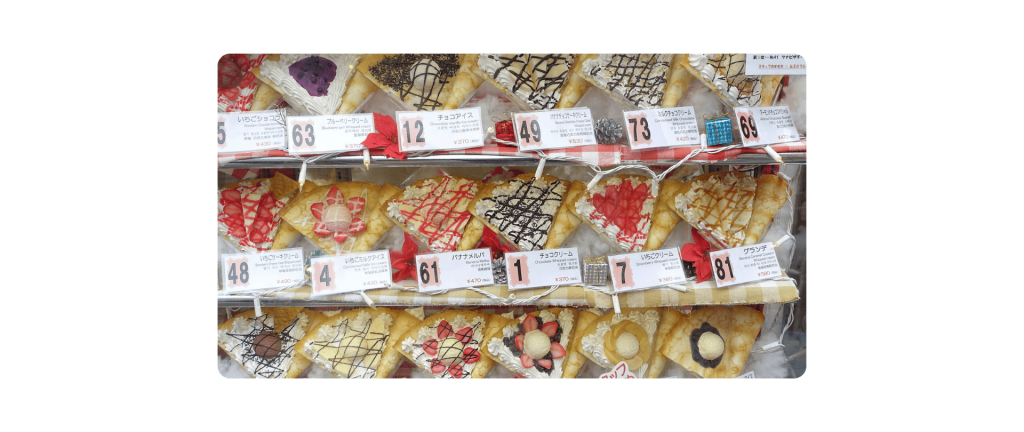
Japanese-style crêpe
Japan, Taiwan
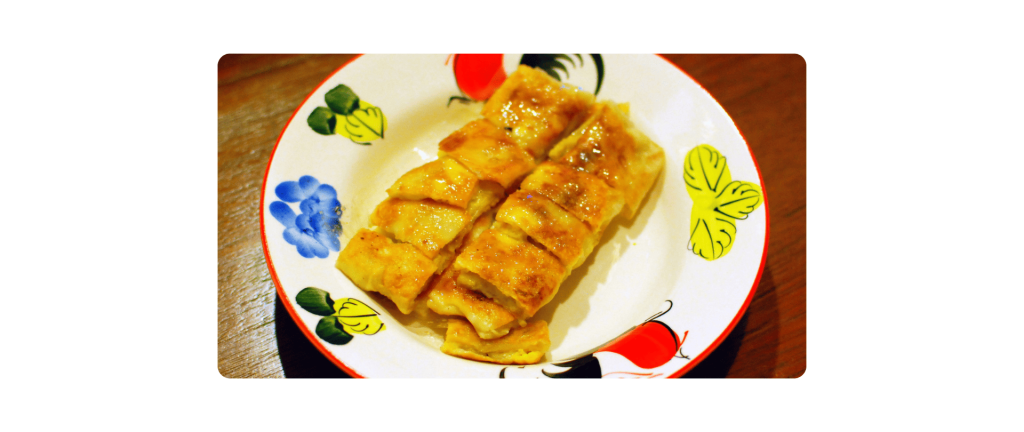
Banana roti
Thailand
Khanom bueang
Thailand
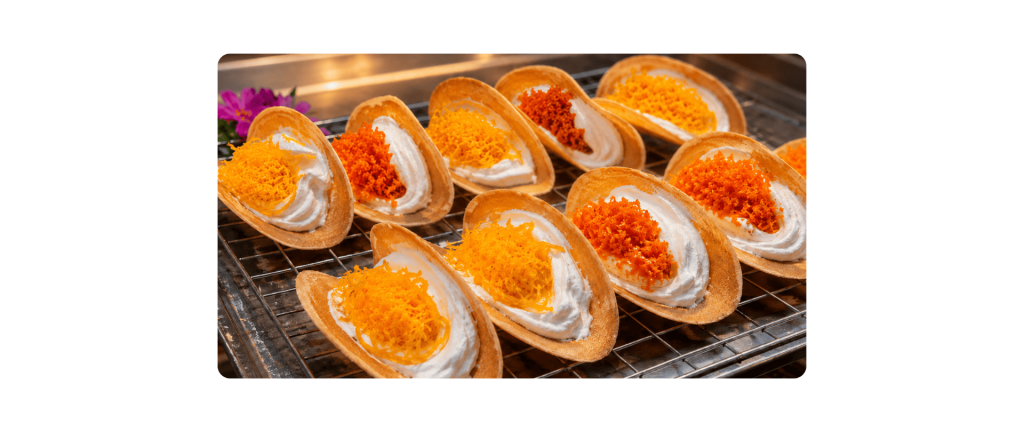
While banana roti reflects Thailand’s vibrant street-food culture, the country also has older and more traditional crêpe-like specialties. One of the most distinctive is khanom bueang, an ancient dessert from central Thailand that was once associated with the upper class and even prepared by the royal court as a merit-making offering to Buddhist monks during the first lunar month. Traditionally enjoyed during the river prawn season in winter, it has a long history rooted in both seasonality and courtly culture.
Khanom Bueang is often described as a Thai crêpe, yet it is quite different from its French counterpart. Its shell is thinner, crispier, and usually folded into a half-moon shape, almost like a miniature taco. It comes in both savory and sweet versions, the latter typically spread with a sweet meringue made from whipped egg whites and sugar, then topped with grated coconut and foi thong (egg yolk threads).
Because of the skill required to spread the batter thinly and evenly, it has long been regarded as a dessert that reflects the craftsmanship of Thai women. Today, khanom bueang is no longer confined to any particular festival or season. Widely available across Thailand, it remains one of the country’s most distinctive traditional sweets and was recognized as part of Thailand’s national intangible cultural heritage in 2013.
Apam balik
Malaysia, Indonesia, Singapore, Brunei
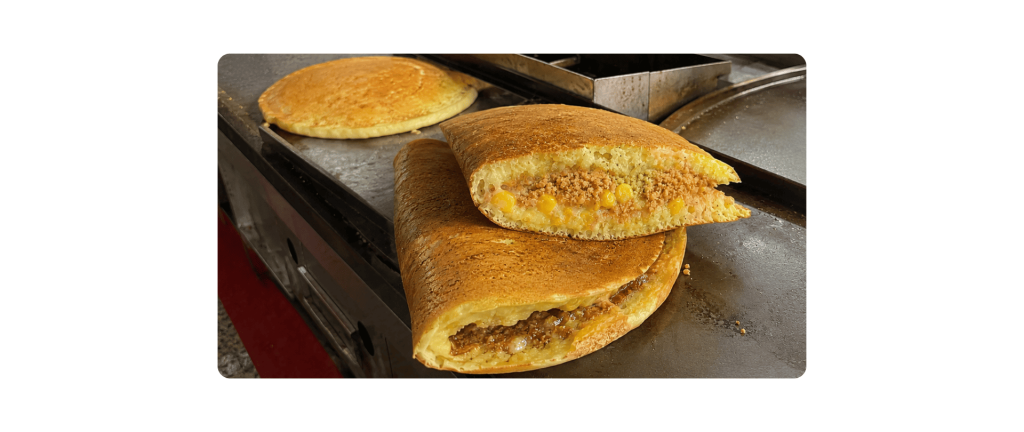
Apam balik is believed to have its roots in Fujian, China, where an early version of the pancake was said to have been created as a portable snack for soldiers. As peanuts were widely grown in Fujian, they became one of the earliest and most important fillings. Over time, the pancake traveled south with Hokkien migrants and gradually became a familiar street food across Southeast Asia. Today, it appears under many different names: apam balik in Malaysia and Brunei, min jiang kueh (曼煎粿) in Singapore and among Chinese-speaking communities, and martabak manis in Indonesia.
Folded into its signature half-moon shape, apam balik is often described in English as a “turnover pancake”. The most traditional version is filled with crushed peanuts, sugar, butter, and sweet corn. It generally comes in two main styles: a thick, fluffy version with a honeycomb-like interior, or a thinner, crispier one with brittle edges.
In Malaysia and Singapore, the classic peanut-and-corn filling remains the most familiar and beloved. In Indonesia, however, versions such as martabak manis are often thicker and far more indulgent, topped with ingredients such as cheese, chocolate, condensed milk, or even ketan hitam kelapa (black glutinous rice with grated coconut). Despite its strong association with roadside stalls, apam balik is also a treat that can be easily recreated at home.
Kuih ketayap
Malaysia, Indonesia, Singapore, Brunei
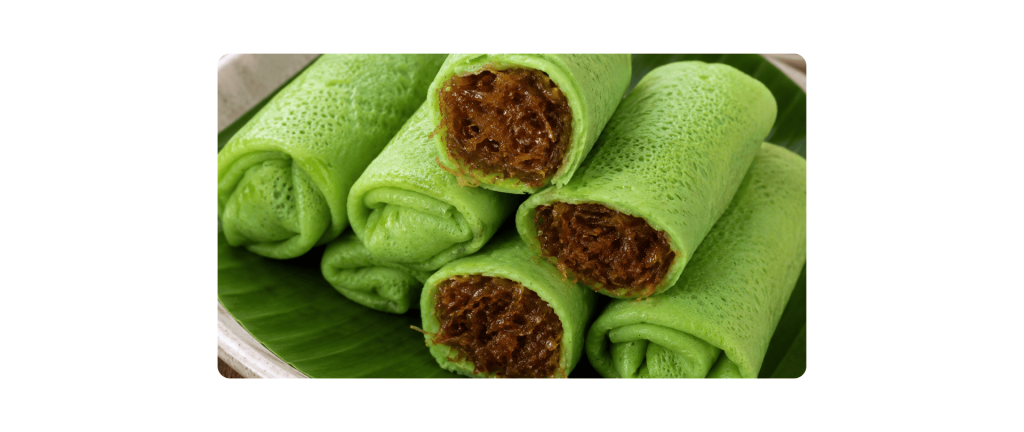
Kuih ketayap is a rolled crêpe filled with sweetened grated coconut. It has its roots in the Malay and Peranakan communities and is familiar across Malaysia, Singapore, Brunei, and Indonesia. The word kuih refers broadly to traditional snacks, while ketayap is said to refer to the small, brimless skullcap worn by an imam. The dessert is believed to have earned this name because its rolled shape resembles the cap. In different places, it is also known by other names, such as kuih dadar (with dadar meaning omelette or pancake) and kuih gulung (meaning “rolled kuih”).
One of the most recognizable features of kuih ketayap is its vibrant green color, obtained from pandan juice. Often considered one of Southeast Asia’s most emblematic plants, pandan is valued not only as a natural coloring ingredient but also for the delicate vanilla-like and floral aroma it brings. The filling is traditionally made by cooking grated coconut with gula melaka, a type of palm sugar solidified in bamboo tubes, which gives the dessert its distinctive caramelized and slightly smoky sweetness.
The wrapper itself is not made too thin, as it needs to hold the filling securely, but it should not be too thick either, so that it retains a soft and slightly chewy texture. Combined with the fibrous texture of coconut and the deep caramel notes of palm sugar, it creates one of Southeast Asia’s most iconic flavor combinations: pandan, coconut, and palm sugar.
Mille-crêpes
Japan
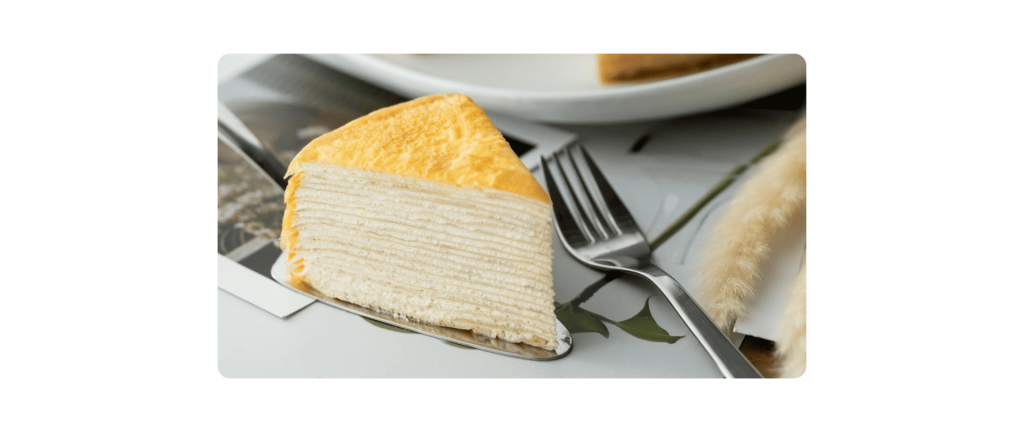
Mille-crêpes has a French name, but the dessert was born and developed in Japan. In French, mille means “a thousand,” referring to the cake’s multi-layered structure. It is a labor-intensive dessert built on thin crêpes, typically made from cake flour, eggs, sugar, melted butter, milk, and vanilla. The key lies in preparing a smooth, even batter and cooking crêpes that are thin yet flavorful. Between the layers, pastry chefs often use lightly whipped cream, sometimes combined with custard, or even crème diplomate (a mixture of custard and whipped cream). Once these silky creams are alternated with 12 to 20 crêpe layers, the result is a cake celebrated not only for its light, melt-in-the-mouth texture, but also for the striking beauty of its clean, delicate cross-section.
Among the many stories surrounding its origin, recent Japanese reporting points to chef Toshinari Sekine as the key creator of the modern mille-crêpes. In an interview with Toyo Keizai, Sekine explained that the cake reached its recognizable form in 1988. Before that, he had worked in the restaurant Ruelle de Derrière in 1986, where he first developed layered crêpe desserts inspired by the French crêpe Suzette. He later turned this idea into the mille-crêpes, inspired in part by the layered structure of lasagna. Sekine also later took part in the development of mille-crêpes products for the coffee chain Doutor Coffee, helping the dessert move beyond a creative restaurant specialty and into the Japanese mass market.
Today, mille-crêpes has evolved far beyond its original pastry-shop setting and can now be found in cafés, retail channels, and frozen dessert formats across Asia. Even as the dessert expanded into larger-scale distribution, high-quality production still relies heavily on craftsmanship. Some specialized producers, including partners Gourmet Selection works with in Japan, continue to assemble the cakes by carefully layering the crêpes by hand rather than by machine, as the crêpes are so thin and delicate that automated assembly can easily damage their texture and appearance. This attention to detail remains one of the defining elements behind the dessert’s refined texture and visual elegance.
All these different interpretations highlight just how diverse and adaptable crêpes can be across the APAC region. Differences in batter, technique, texture, folding methods, and local ingredients have given rise to remarkably varied specialties, while reinterpretations such as Japanese mille-crêpes also show how crêpe-based desserts developed in Asia can later gain international recognition far beyond their original market. Of course, this article only explores a small part of the crêpe universe, focusing mainly on sweet varieties. Once savory preparations enter the picture, the diversity becomes even broader, from Taiwan’s dan bing and China’s jian bing to South India’s dosa and Vietnam’s bánh xèo.
At Gourmet Selection, understanding regional food cultures and consumption trends is closely connected to the partnerships we develop across Europe and Asia. By working with carefully selected producers – from traditional specialists to innovative dessert manufacturers – we aim to offer buyers and foodservice professionals products that combine quality and strong relevance for their markets.
Sources
マリオンクレープ/MARION CREPES. https://marion.co.jp/
Crêpe ou galette ? Quelle différence entre une crêpe et une galette bretonne ? (2021, February 1). Golfe du Morbihan Vannes Tourisme. https://www.golfedumorbihan.bzh/terroir/crepe-ou-galette/
Crêpes – Takeshita street – Tokyo. (2015). Daderot, CC0, via Wikimedia Commons. https://commons.wikimedia.org/wiki/File:Cr%C3%AApes_-_Takeshita_street_-_Tokyo_-_DSC07883.JPG
Crêpes et galettes : découvrez tous leurs secrets ! (2026, February 9). Région Bretagne. https://www.bretagne.bzh/actualites/crepes-et-galettes-decouvrez-tous-leurs-secrets/
Groundwater, B. (2023, April 23). The backpacker dish so famous they named a whole region after it. The Sydney Morning Herald. https://www.smh.com.au/traveller/inspiration/the-backpacker-dish-so-famous-they-named-a-whole-region-after-it-20230411-p5czlt.html
How to make vegan Roti Pisang (Banana). (2021, October 16). WoonHeng. https://woonheng.com/vegan-roti-pisang-banana/
Junior, D. (2025, March 25). Malaysian Kuih Dadar (Pandan Crepes with Coconut Filling). DelishGlobe. https://delishglobe.com/recipe/kuih-dadar-pandan-crepes-with-coconut-filling/
Lelait-Helo, D. (2026, April 16). Gavottes : l’histoire fascinante du biscuit breton en dentelle. Côté Maison. https://www.cotemaison.fr/design/gavottes-l-histoire-fascinante-du-biscuit-breton-en-dentelle-17892
Lieu, K. (2023, July 3). The Difference Between Traditional French And Japanese Crepes. Tasting Table. https://www.tastingtable.com/1325470/the-difference-between-traditional-french-and-japanese-crepes/
Min Jiang Kueh. (2021, September 11). SG101. https://www.sg101.gov.sg/resources/archives/heritage-min-jiang-kueh/
Roti kluai khai. (2010). Takeaway, CC BY-SA 3.0, via Wikimedia Commons. https://commons.wikimedia.org/wiki/File:Roti_kluai_khai_chiang_mai_04.jpg
ภูมิปัญญาขนม (ใน) ไทย : ขนมเบื้อง. (2022, May 28). Intangible Cultural Heritage of Thailand. https://ich-thailand.org/article/detail/6291f35836ab3f111c5572b8
スイーツビレッジ. (2026, April 8). ミルクレープの全て:日本で花開いた歴史、その魅力、手作りレシピ、そして世界の広がり. スイーツモール. https://shop.sweetsvillage.com/blogs/knowledge/millecrepes?srsltid=AfmBOoqD4KKqglvgd25mrHcxyQGzlx5qzilsPLhy_OVKIFeByTwmVR57&utm
阿古真理. (2025, May 8). 実は「日本発祥スイーツ」ミルクレープが人気上昇中、”生みの親”が語る専門店誕生の舞台裏。ミルクレープ発想の原点はラザニア. 東洋経済オンライン. https://toyokeizai.net/articles/-/875394?page=2


