
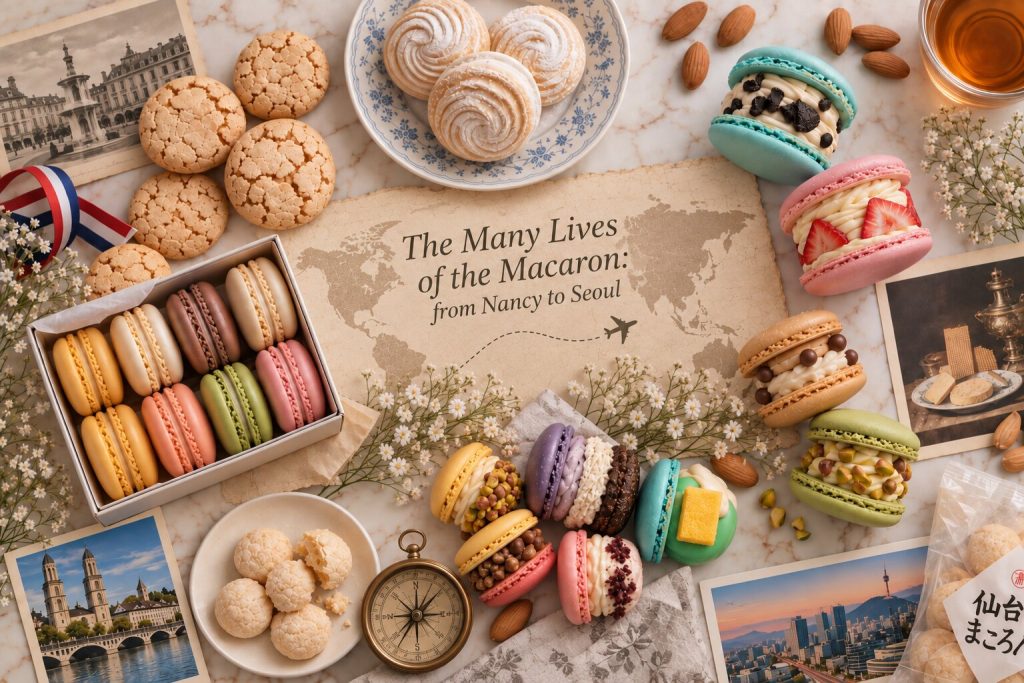
France: not one macaron, but many
What we actually know about its origins
The macaron’s origin story is repeated so often that it is worth separating tradition from historical evidence. The popular version has Catherine de’ Medici bringing it from Florence in 1533. It makes a good story, but a review of the records of staff who served Catherine from her arrival in France until her death found no Italian chefs among them. What is better documented is that the word macaron appears in French writing by the mid-16th century, with Rabelais using it in Le Quart Livre in 1552, and that the name most likely traces back to the Italian maccarone or maccherone, meaning paste. Ladurée’s own history page is refreshingly honest about this, describing the pastry’s past as a patchwork of traditions, legends and craftsmanship rather than a straight line, with possible Middle Eastern as well as Italian influences.
The regional macarons
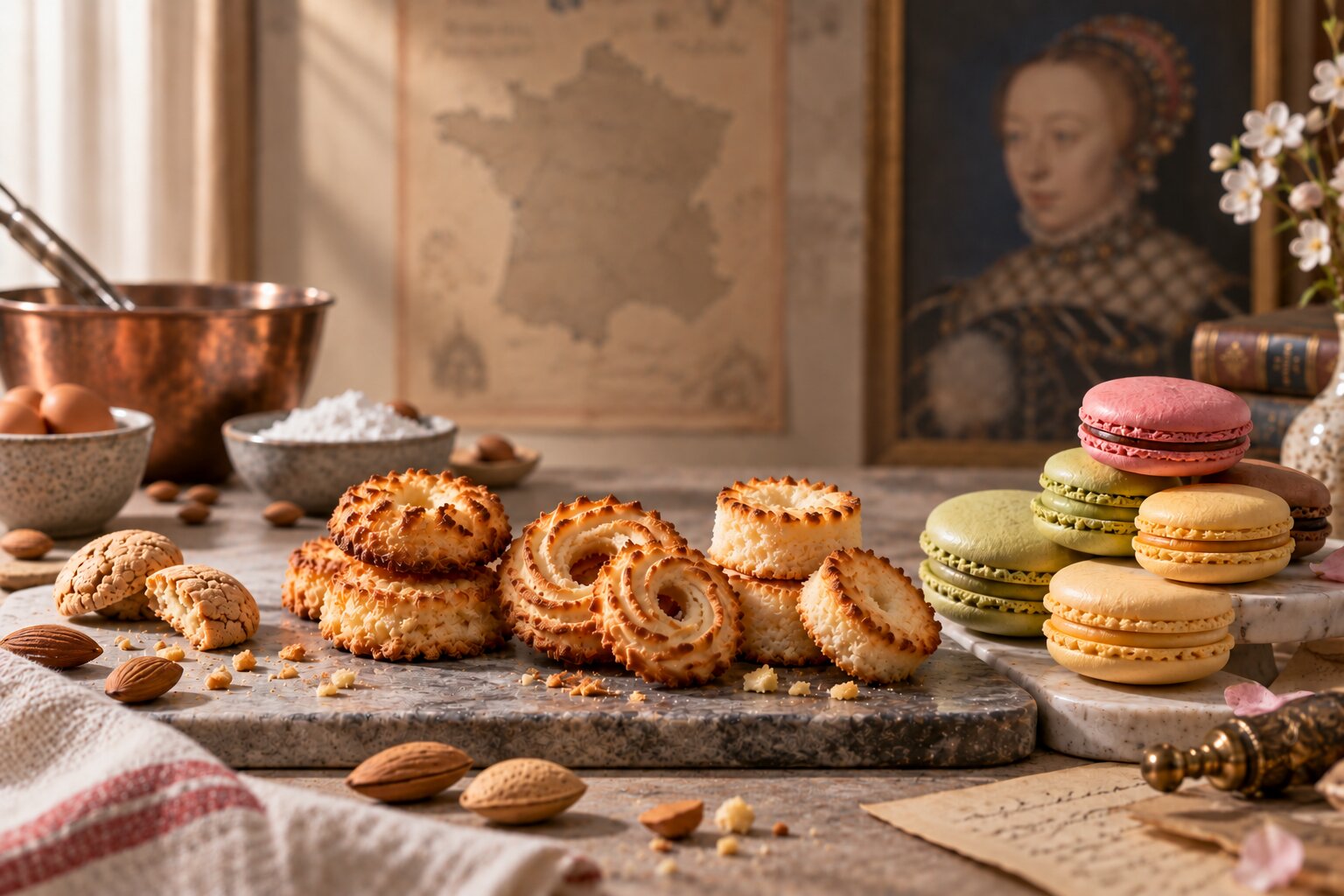
What France definitely did was multiply the thing. Nancy, Amiens, Saint-Émilion, Saint-Jean-de-Luz, Montmorillon, Boulay, Cormery: many built their own version around the same basic trio of egg white, almond and sugar. The differences come from the ratios, the grind of the almonds, resting time and baking.
The best known is the macaron de Nancy, traditionally linked to convent baking in Lorraine and to two former nuns who, after the religious communities were dissolved during the Revolution, are said to have sold macarons to support themselves. They became known as the Sœurs Macarons. The commonly cited founding date of 1793 should be handled with care, since regional heritage research notes that nothing in the archives confirms it. The biscuit itself is unmistakable though: flat, with a cracked, matte surface, crisp at the edge and soft inside, and often still sold stuck to the sheet of baking paper it was cooked on.
The key point for anyone comparing France to Asia is that most of the traditional regional macarons are single biscuits with no filling. The version the rest of the world now calls a macaron is a much later, and much more Parisian, invention.
The Parisian macaron
The macaron parisien, also known as macaron lisse, made of two smooth coloured shells sandwiching a ganache, buttercream or jam, is closely tied to the history of Ladurée, founded on Rue Royale in 1862. The house credits Pierre Desfontaines, a cousin of the founder, with the idea of joining two shells around a ganache. The date is usually given as the 1930s, though Ladurée’s current wording places filled macarons in Paris as early as the 1830s and describes Desfontaines as having perfected the format. A rival claim exists too: another baker, Claude Gerbet, also claimed the invention, which is why the format was once known as the “Gerbet” or simply the “Paris macaron”.
If Ladurée created the object, Pierre Hermé turned it into a category. Trained under Gaston Lenôtre, he worked at Fauchon and then Ladurée before founding his own house, treating macarons like fashion collections with seasonal flavour launches, and creating Macaron Day on 20 March, celebrated since 2005.
The technical reality behind the elegance is worth stating, because it explains almost everything that follows in Asia. A Parisian shell is rarely more than 4 cm across. It is made from almond flour, icing sugar and egg white, at Ladurée using an Italian meringue, where sugar syrup heated to 120°C is poured into whipped whites, which is what gives the shells their gloss. The piped batter must be left to dry before baking so that a pied, the little ruffled foot at the base, forms rather than a crack. There is no flour, no added fat and no structure to hide behind. It is also, by construction, extremely sensitive to humidity: too much moisture in the air can interfere with skin formation before baking and soften the shells afterwards.
The part nobody sees: macarons at industrial scale
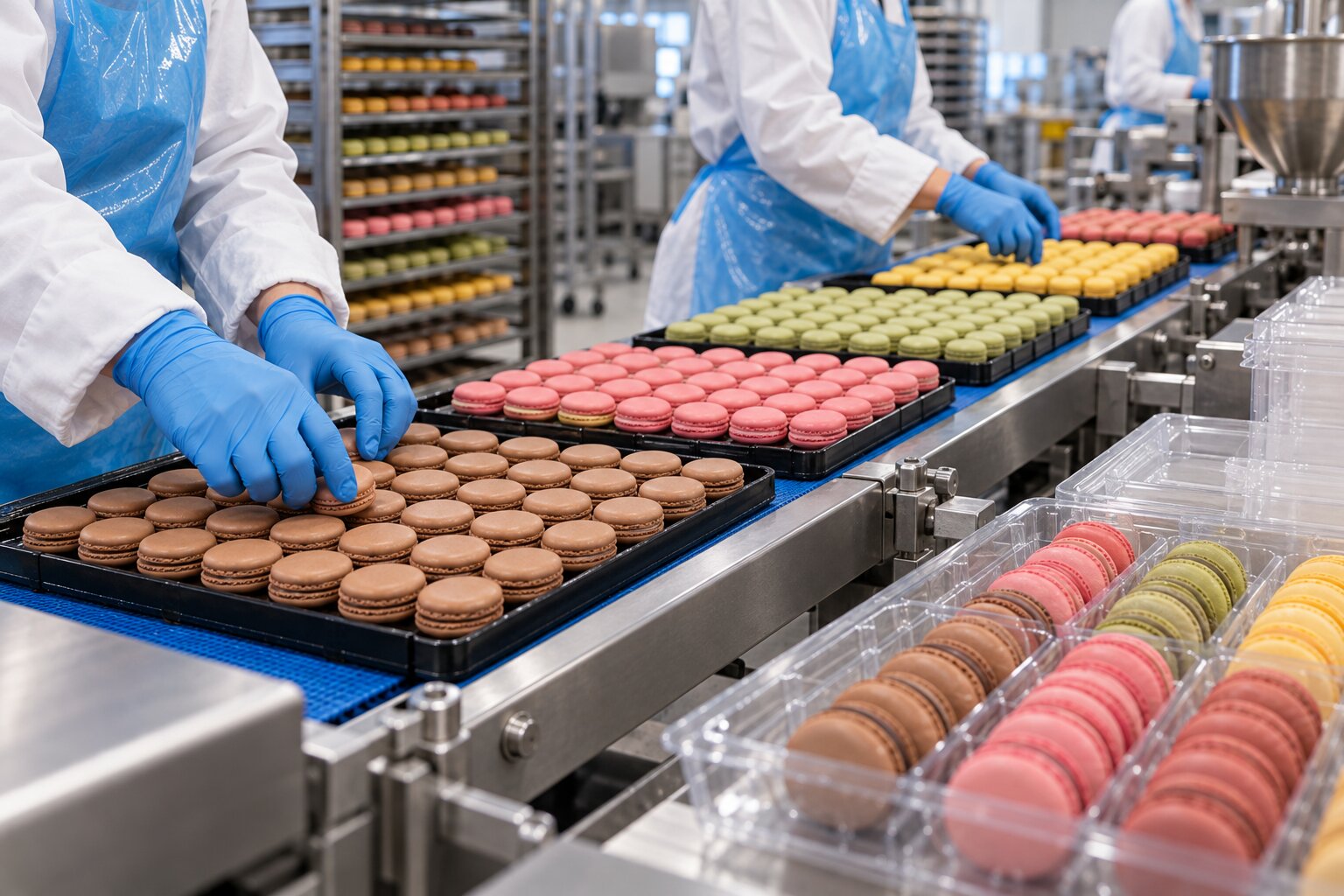
There is a reason the macaron stayed a luxury item for most of its history. A product with no flour, no added fat and a three-ingredient shell leaves no margin for error, which traditionally meant small batches, high labour costs and a very short distribution radius. A boutique macaron in Paris is still priced accordingly.
What changed over the past two decades is the emergence of a tier of European manufacturers, almost invisible to consumers, that learned to make a genuinely good macaron at volume. It is a harder engineering problem than it sounds. Producing thousands of identical shells requires highly controlled dosing, piping, baking, filling and freezing processes, followed by packaging designed to protect a fragile product through storage and long-distance transport. European manufacturers generally operate under recognised food-safety certifications such as IFS and BRC. Freezing has also transformed the logistics of the product: instead of being made to order and consumed within days, macarons can now be produced centrally, frozen, shipped internationally and finished locally by thawing under controlled conditions.
The result is easy to underestimate. A pastry that in 1930 existed in a handful of Parisian streets can now be served in a hotel in Bangkok, a café in Auckland or a supermarket in Seoul, at a price a foodservice operator can actually build a menu around. Industrial producers have also pushed the format further than the boutiques did, developing savoury macarons for aperitif and catering menus, printed and personalised macarons for events and corporate gifting, pre-packed retail boxes, and unfilled shells sold as a component, allowing pastry chefs to create their own fillings, entremets or frozen desserts around a shell they would otherwise have to produce in-house.
Industrial is not the opposite of authentic here. It is what made the macaron a global product rather than a souvenir.
Switzerland: the Luxemburgerli
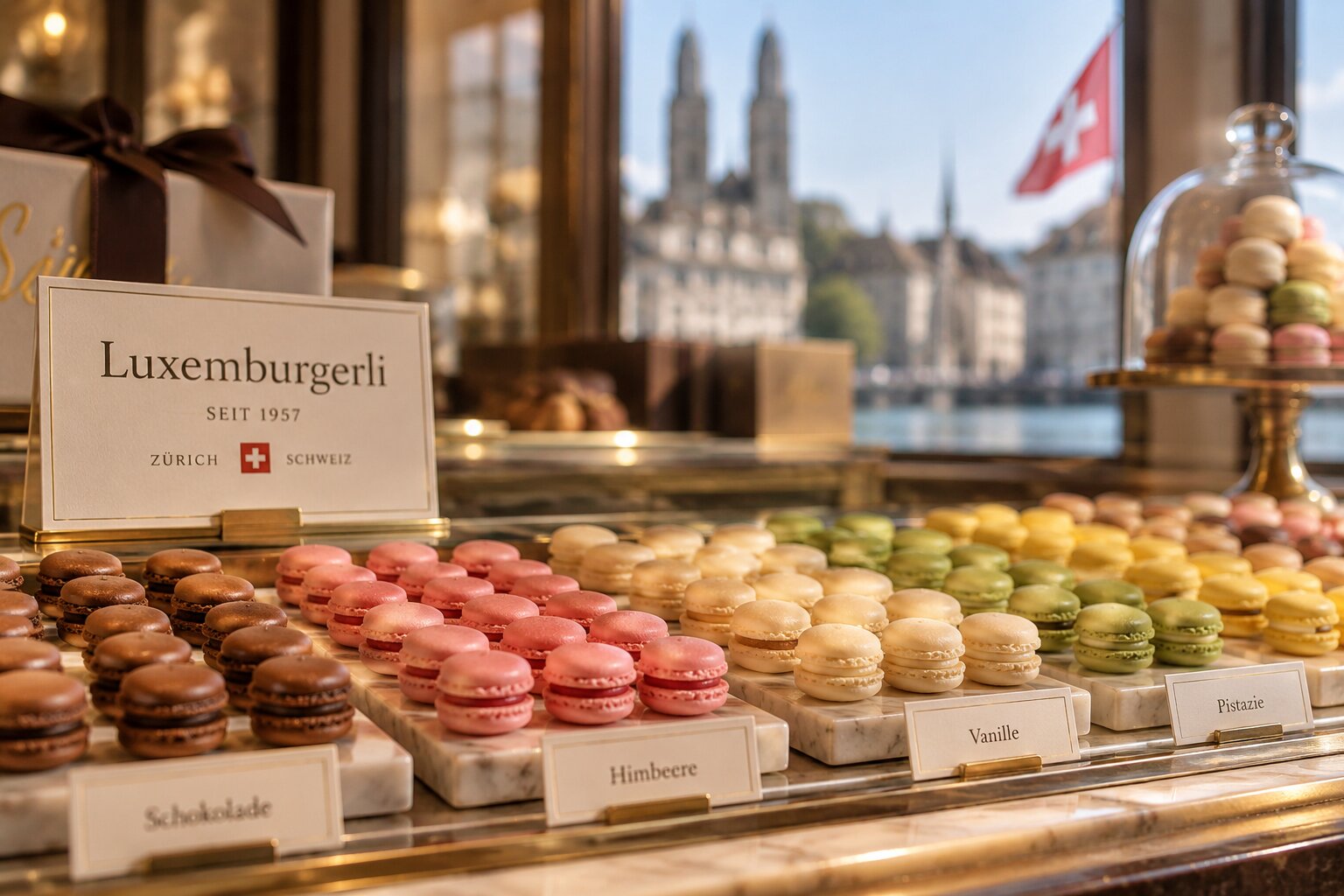
Before heading east, a short detour to Zurich for one of Europe’s most successful macaron variants. The Luxemburgerli is the flagship product of Confiserie Sprüngli, first sold in 1957. It came to Zurich with Camille Studer, a young confectioner whose family came from Luxembourg and whose father was a chef-confiseur there. The recipe was refined at Sprüngli under Richard Sprüngli, and the name comes from the nickname Studer’s colleagues had given him.
At around 2.5 cm in diameter it is noticeably smaller than a French macaron, and considerably lighter, closer to a mouthful of flavoured air than to a pastry. Sprüngli now produces roughly 650 kg of them a day, and the name is a registered trademark. The trade-off is fragility: the airy texture starts to go within a day or two depending on humidity and filling, so Luxemburgerli are sold to be eaten almost immediately. It is a useful reminder that in this product family, texture and shelf life are the same conversation.
Asia: four very different answers
Makoron – Japan
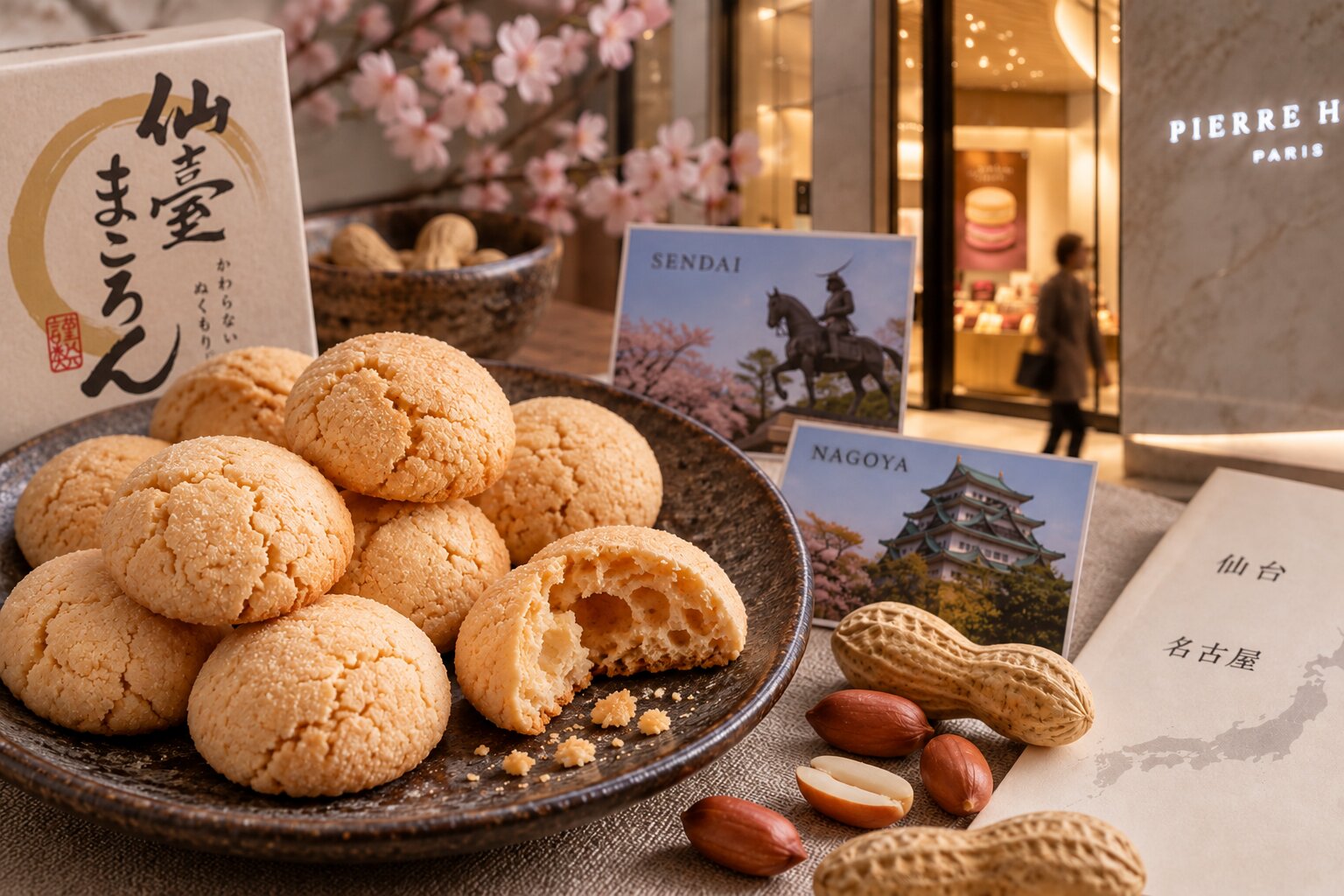
Japan had its own take on the macaron long before the Parisian version arrived. Makoron (マコロン / まころん) is built on the same idea but made with peanuts instead of almonds, ground and mixed with egg white and sugar. Japanese accounts of where it came from do not fully agree. One tradition places it in Sendai, where it survives today as part of the city’s dagashi culture of old-fashioned sweets. Another, more widely cited, credits Makoron Seika in Nagoya, a company founded in 1924, whose head set out to recreate the French macaron using peanuts, far easier to source in Japan than almonds; the product then spread mainly across the Tōkai region. Either way the result is the same: a small, pale-brown, crisp, hollow biscuit with no filling, perhaps closer to the original Italian maccarone or amaretti di Saronno, than to anything in a Paris window.
The French macaron’s own arrival in Japan is a good market-entry story in itself. Pierre Hermé opened his very first boutique not in Paris but in Tokyo, in 1998, at the Hotel New Otani, three years before the Rue Bonaparte shop. It became a commercial success, but not immediately: according to the brand’s own account of those early days, Japanese consumers initially had no interest in the macarons, taking them for badly made monaka. Japan then became a creative engine for the product rather than just a market, with yuzu, matcha, sesame and other local ingredients feeding back into French flavour ranges.
Gû-li̍k (牛粒) – Taiwan
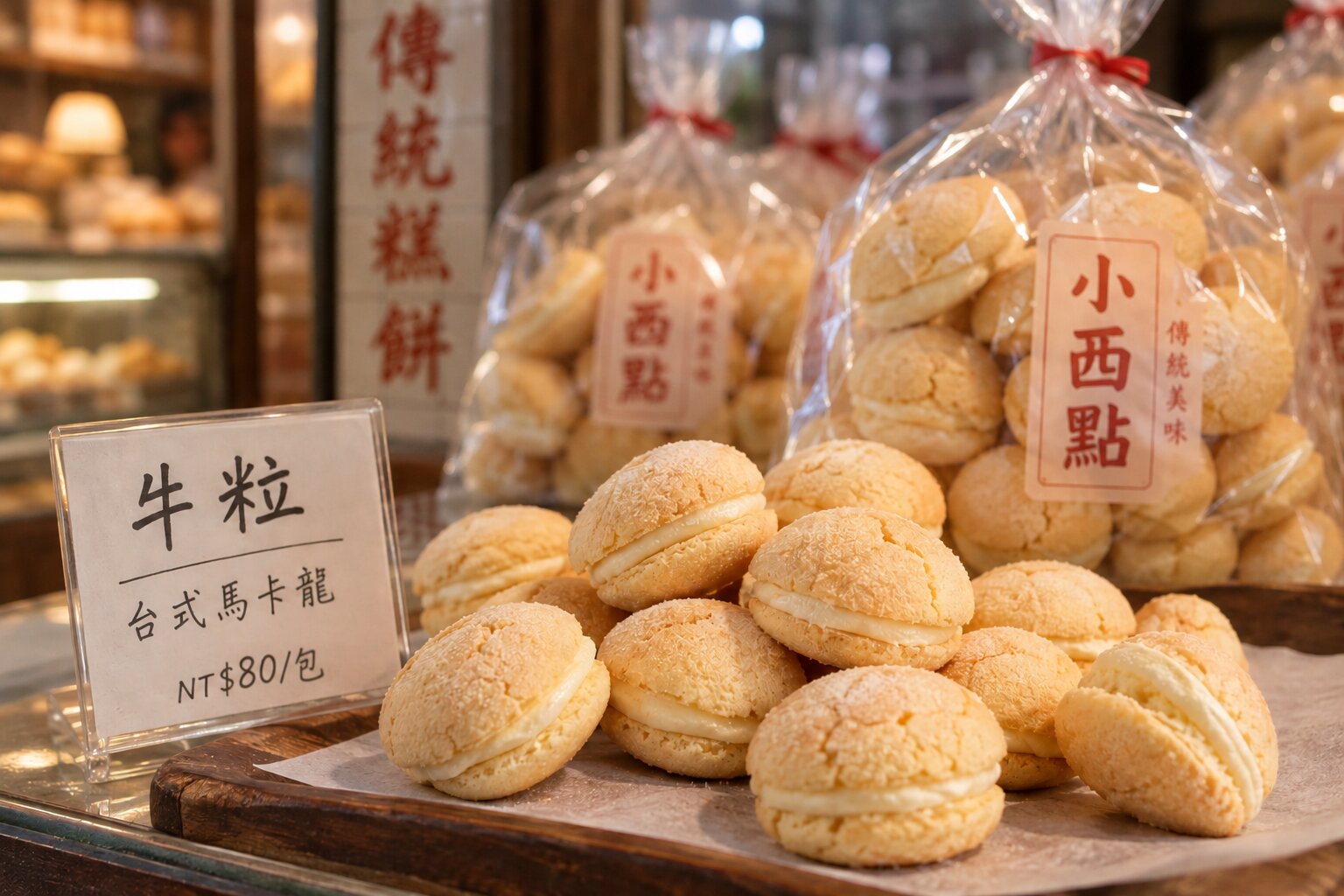
Walk into an old-style Taiwanese bakery and you will find plastic bags of small, domed, pale-gold biscuits sandwiching a thin layer of buttercream, sold for a few dozen NT dollars. They are usually labelled 小西點 (xiǎo xīdiǎn, “little western pastry”) and popularly called 牛粒, pronounced gû-li̍k in Taiwanese. Since the French macaron arrived, they have also picked up the nickname 台式馬卡龍, the Taiwanese macaron.
They are not macarons at all, and the etymology explains why. The recipe came through Japan during the colonial period, derived from the French biscuit à la cuillère (ladyfinger) and the bouchée (ブッセ in Japanese). Japanese pastry chefs taught Taiwanese apprentices using Japanese renderings of French words, and gû-li̍k is what cuillère became after passing through Japanese and then into Taiwanese. The same process produced the alternative names 麩奶甲 and 福令甲, from the Japanese pronunciation of the English “ladyfinger”.
The product then became a bakery staple during the US aid period (1955 to 1965), when large volumes of American wheat, corn and soy arrived in Taiwan and the government actively encouraged flour consumption. Technically it is a whole-egg sponge batter, made of eggs, sugar and flour rather than almond meringue: softer, far less sweet, with no pied to worry about and none of the precision a macaron shell demands. Interestingly, ladyfingers in Italy and France are not filled, so the buttercream appears to be a Taiwanese addition, and it does useful work by keeping the airy biscuit slightly moist. The authentic French macaron only really arrived in Taiwan in the 2000s, brought back by a generation of chefs who had trained in France, which is why the two coexist today in completely different retail worlds.
Ttungcaron (뚱카롱) – South Korea
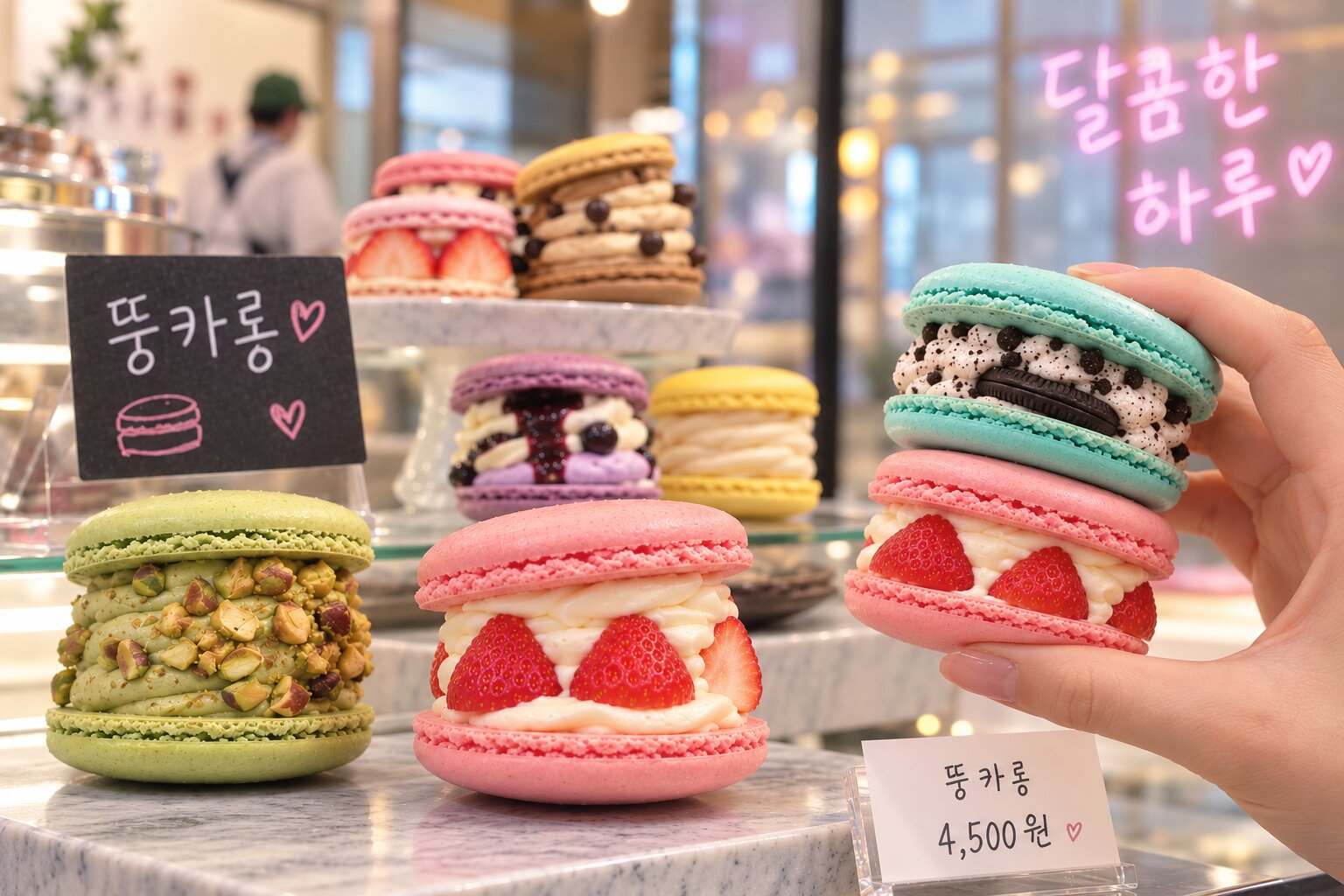
South Korea did not localise the macaron by changing the recipe. It changed the proportions. The ttungcaron (뚱카롱), from 뚱뚱하다 meaning “fat” plus macaron, sometimes rendered in English as “fatcaron”, keeps the French shell and multiplies the filling.
The numbers make the point. A macaron parisien has shells around 4 cm across and stands about 1.5 cm tall, with a thin layer of filling. A ttungcaron has shells of 5 to 6 cm and a total height of 4 to 6 cm, with buttercream several centimetres thick, and many shops bake the shells thicker to balance the richness. The format emerged organically around late 2016 and early 2017, with several small shops independently thickening their fillings at the same time and one Yongin bakery claiming to have coined the word along with the now-standard photo of two or three macarons pinched between thumb and forefinger. By 2019, roughly 3,100 macaron shops were registered on Naver Maps in the greater Seoul area alone, most of them selling the thick version, with queues forming hours before opening.
Why there, and why that shape? Korean coverage of the phenomenon points to a cultural distinction that is directly relevant to product design. European dessert is a small full stop at the end of a meal, whereas the Korean equivalent occasion is closer to a snack between meals, where a degree of fullness is expected. Buyers surveyed described the appeal in terms of size, a chewy texture, and, counter-intuitively for a sugar-based confection, being less sweet than the original. That is not a contradiction: French pastry chefs working in the region have noted that recipes for Asia are routinely reformulated with roughly 15% less sugar. Flavour development went the same way, with fillings built around familiar supermarket biscuits, ice creams and local ingredients such as injeolmi soybean powder. Meanwhile the Parisian original struggled, with Ladurée opening in Seoul in 2016 and withdrawing the following year.
The look followed the same logic as the format. A macaron designed to be photographed is a macaron designed to be seen from across a room, and Korean shops pushed the colour as hard as they pushed the proportions.
Colour, not proportion – Mongolia
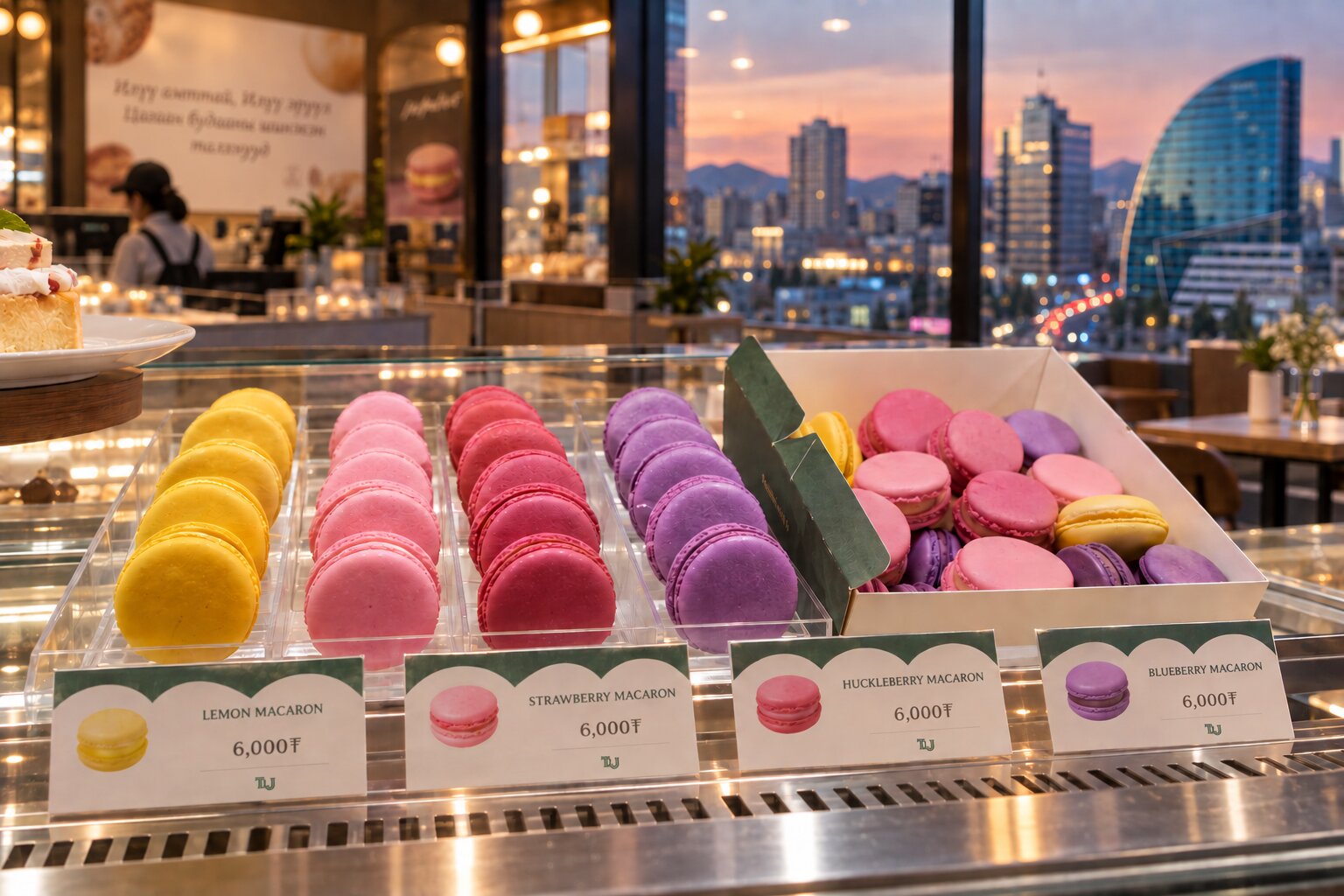
Not everything travels at the same speed. The ttungcaron format itself has stayed largely within Korea, but the visual register that came with it has not, and the route it took to Ulaanbaatar is worth following. The Korean bakery chain Tous les Jours entered Mongolia in 2016, the first Korean bakery brand in the country, through a master franchise agreement with a local partner. It now runs 24 stores, several of them well beyond the capital in Darkhan and Ulaangom, and reports having sold more than 1.7 million cakes there in ten years, roughly one for every two Mongolians. This is the modern retail growth we described in our earlier piece on entering Mongolia’s F&B market, seen from the dessert counter. For a great many consumers in Ulaanbaatar, the macaron did not arrive from Paris. It arrived from Seoul.
What strikes our team on the ground is the colour. The flavours themselves are unremarkable, the same lemon, strawberry and berry range you would find in France, but the palette is pushed several tones further: candy pink, deep raspberry, vivid lilac and a strong lemon yellow, lined up by colour in the cabinet and packed several shades to a box. It is the same product doing a different job. In Paris, the muted palette is part of what signals refinement and heritage. In a market where the macaron arrived recently and carries no historical baggage, colour signals something else entirely: novelty, celebration, and a product worth photographing and giving. The format, though, stayed put: the macarons themselves are conventionally proportioned, thin-filled, nothing like a ttungcaron. What crossed the border was the palette, not the profile.
This matters more than it looks for anyone building an export range. Colour is usually treated as a fixed brand asset decided in Europe, yet it is one of the few specifications that costs almost nothing to adapt and that consumers read immediately. A pastel assortment designed for a French retail shelf can simply look faded on a counter where the competing products are bright.
What this means for European producers
Put these markets side by side and a pattern appears. The shell is the part nobody wants to make, and the filling is the part everyone wants to change. Taiwan and Japan avoided the almond meringue entirely by substituting local ingredients. Korea kept the shell and rebuilt everything around it. In practice, that is an argument for supplying the technical component and leaving room for local adaptation, which is exactly what a frozen shell or a made-to-order flavour range does.
A few other constants are worth keeping in mind when a European macaron heads for Asia:
- Humidity is a supply chain issue, not just a kitchen issue. In tropical and subtropical markets, humidity becomes an especially important consideration during thawing. The usual professional approach is to thaw slowly in the refrigerator and keep the product in its sealed packaging until it reaches temperature, rather than opening it cold.
- Filling choice determines shelf life. Stable ganaches and buttercreams travel, while high-moisture fruit fillings tend to migrate into the shell. A thin chocolate or buttercream barrier on the inside of the shell is the usual remedy.
- Sweetness needs recalibrating, and buyers will say so explicitly in tastings.
- Format and price per piece vary sharply by market, as the Korean example shows. The same 4 cm macaron reads as refined in one market and as not enough in another.
- Colour is a positioning decision. Pastel says French luxury in some markets, while in others saturated colour is what signals that a product is fun and worth photographing.
None of this makes the French macaron less relevant in Asia. It simply means the version that works is rarely the catalogue version.
At Gourmet Selection, this is the kind of groundwork that sits behind the partnerships we build between European producers and Asian buyers: understanding how a product is actually consumed in a given market, what has to change for it to make sense there, and what should not change at all. If you are working on a pastry or dessert project for the region, or wondering how a European specialty would land in Taipei, Tokyo or Seoul, we are always happy to talk it through.
Sources
Confiserie Sprüngli. Wikipedia. https://en.wikipedia.org/wiki/Confiserie_Sprüngli
Histoire et origine du macaron. Maison Ladurée. https://laduree.com/pages/histoire-du-macaron
La Maison Pierre Hermé Paris dévoile les secrets de son succès chez FAJ. (2016, January). CCI France Japon. https://www.ccifj.or.jp/publications/actus/n/news/la-maison-pierre-herme-paris-devoile-les-secrets-de-son-succes-chez-faj.html
Lee, H. (2016, November 15). CJ Foodville opens bakery in Mongolia. The Korea Times. https://www.koreatimes.co.kr/amp/business/companies/20161115/cj-foodville-opens-bakery-in-mongolia
Le macaron, une longue histoire. (2018, November). Lorraine Magazine. https://www.lorrainemag.com/art-et-gastronomie/le-macaron-une-longue-histoire/
Le Luxemburgerli, ou la savoureuse histoire d’une douceur zurichoise. (2002, May 24). Le Temps. https://www.letemps.ch/societe/luxemburgerli-savoureuse-histoire-dune-douceur-zurichoise-envoute-palais
Luxemburgerli, the original macaron from Confiserie Sprüngli. Sprüngli. https://www.spruengli.ch/en/spruengli-world/luxemburgerli.html
Macaron. Wikipedia. https://en.wikipedia.org/wiki/Macaron
Macaron de Nancy. Wikipédia. https://fr.wikipedia.org/wiki/Macaron_de_Nancy
Pierre Hermé. Wikipédia. https://fr.wikipedia.org/wiki/Pierre_Hermé
Pies and Tacos. (2021). Macarons and humidity. https://www.piesandtacos.com/macarons-and-humidity/
Tous Les Jours marks 10th anniversary in Mongolia, expands footprint in Indonesia. (2026, April 7). The Korea Times. https://www.koreatimes.co.kr/business/companies/20260407/tous-les-jours-marks-10th-anniversary-in-mongolia-expands-footprint-in-indonesia
古早味點心揭密 台式馬卡龍本名是它. 人間福報 / 蔬福生活, d’après 莊雅閔, 《古早味台式點心圖鑑》. https://vegemap.merit-times.com/veganews_detail?id=6050
台式馬卡龍「牛粒」命名竟跟法語、日語、台語都有關?(2024, November). 食力 foodNEXT. https://www.foodnext.net/life/culture/paper/6351022297
牛粒. 維基百科. https://zh.wikipedia.org/zh-tw/牛粒
風靡全球的馬卡龍旋風. 食力 foodNEXT. https://www.foodnext.net/life/culture/paper/5234856401
송윤경. (2019, May 4). [커버스토리] 마카롱은 왜 한국에서 ‘뚱카롱’이 됐을까. 경향신문. https://www.khan.co.kr/article/201905040600075
<食卓ものがたり>落花生香る、伝統の菓子 マコロン(名古屋市). (2024, December). 東京新聞. https://www.tokyo-np.co.jp/article/75316
マコロンとは?マカロンと違いある? ちそう. https://chisou-media.jp/posts/3647


