
Three chains, three very different trajectories
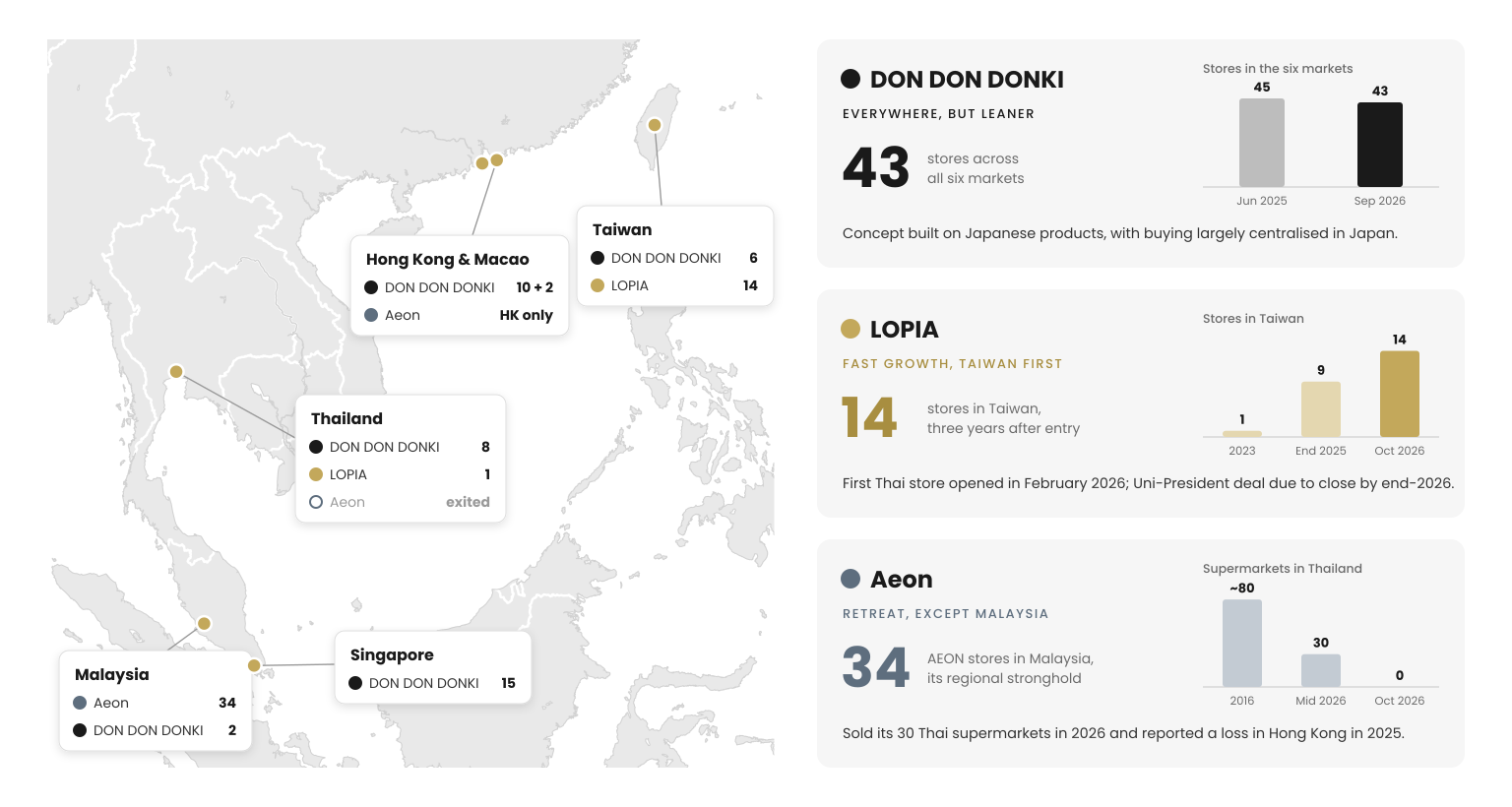
Only one of the three chains is present in all six markets, and only one is clearly growing.
| Market | DON DON DONKI | LOPIA | Aeon |
|---|---|---|---|
| Taiwan | 6 stores | 14 stores (October 2026) | None |
| Hong Kong | 10 stores | None | General merchandise stores, supermarkets, DAISO and Mono Mono shops |
| Macao | 2 stores | None | None |
| Thailand | 8 stores | 1 store (since February 2026) | Exited supermarkets in September 2026 |
| Malaysia | 2 stores | None | 28 malls, 34 AEON stores (February 2024) |
| Singapore | 15 stores | None | None |
DON DON DONKI figures as of 20 September 2026. LOPIA and Aeon figures from company announcements and press reports listed in the sources.
Don Quijote: the Japan brand specialist
Don Quijote’s parent, Pan Pacific International Holdings (PPIH), describes its Asian stores as Japanese brand specialty stores, selling products that are mostly made in Japan or designed for the Japanese market. Food is the core of the model: it accounted for more than 80% of sales in its Southeast Asian stores as early as 2019.
Growth came quickly, and so did the costs. In 2024, the company’s president acknowledged that its Asian stores had become too uniform, that local teams had little ability to source from local manufacturers, and that selling and administrative costs had reached 35% of sales, against 22% for the group’s discount stores in Japan. A restructuring followed, including the closure of underperforming stores, and by late 2025 PPIH said its Asian business was performing above expectations. The network is now leaner: Singapore went from 17 to 15 stores and Malaysia from 3 to 2 between June 2025 and September 2026.
For a European supplier, the key point is structural. Buying is largely centralised in Japan, and the concept is built around Japanese products.
LOPIA: the fast-rising newcomer
LOPIA chose Taiwan as its first market outside Japan in 2023. It had nine stores there by the end of 2025, seven of them inside department stores or shopping malls, and has 14 today, including the first LOPIA PREMIO, which opened in Kaohsiung in September 2026. Thailand followed on 11 February 2026, with a store of around 1,000 m² at Central Chaengwattana, and the company openly presents Taiwan as the template for its international roll-out.
The Taiwanese business is about to change shape. On 30 April 2026, Uni-President, the group behind 7-ELEVEN in Taiwan, agreed to invest around NT$2.05 billion for 51% of a new LOPIA retail company and 49% of a new food-processing company. The deal still needs competition clearance and is expected to close by the end of 2026. According to LOPIA Taiwan’s general manager, the company handling imports and manufacturing remains 51% owned by LOPIA, precisely to keep control over product quality.
Aeon: retreating, except in Malaysia
Aeon is the most established Japanese retailer in the region, but it is pulling back. In Thailand, it transferred its 30 MaxValu and MaxValu Tanjai supermarkets to Central Food Retail in September 2026, marking its exit from the country’s supermarket business. The network had peaked at around 80 stores in 2016, and the group’s investment priority in the region has shifted to Vietnam. In Hong Kong, AEON Stores reported 2025 revenue of HK$3.59 billion, down 4.1%, and a segment loss of HK$192.4 million, citing cross-border shopping in mainland China and competition from Chinese e-commerce platforms. The subsidiary relies on financial support from its parent. Aeon has no stores in Taiwan, Macao or Singapore.
Malaysia is the exception. Aeon opened its first store outside Japan there in 1985, under the Jusco banner, and in early 2024 operated 28 malls and 34 AEON stores, plus MaxValu supermarkets, AEON Wellness pharmacies and DAISO shops. In late 2025 it launched a new premium format, AEON STYLE Supermarket, at Setia EcoHill, with more than 2,000 imported food items on the shelves.
What’s in the freezer
Japanese desserts dominate the frozen aisles of all three chains. The clearest opening for European products is at LOPIA.
DON DON DONKI: Japanese sweets, and Europe seen through Japan
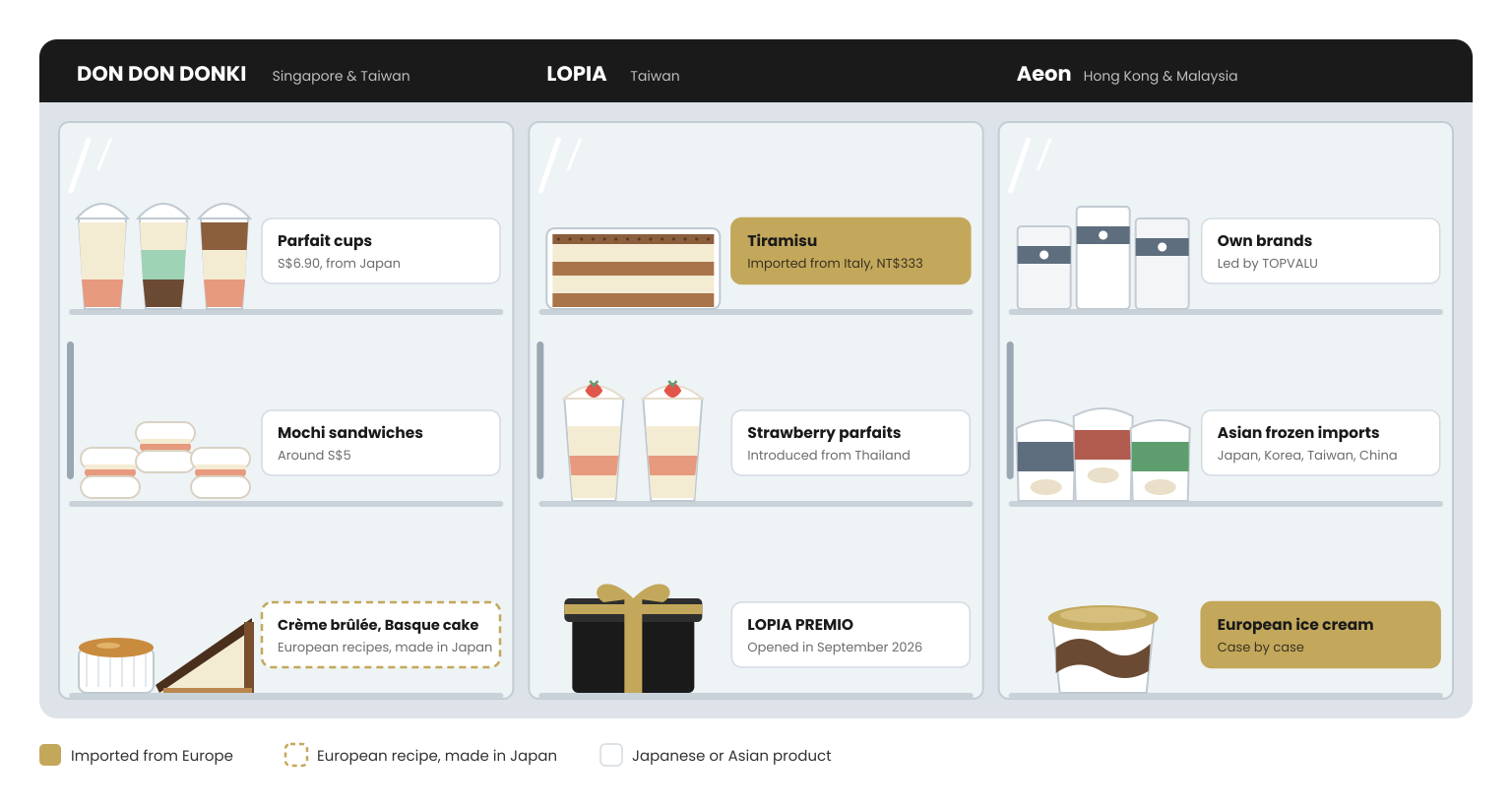
In Singapore, Donki’s freezers carry parfait cups imported from Japan, in flavours such as strawberry cheesecake and chocolate mint, at S$6.90 each when they launched in 2021, alongside mochi sandwiches filled with cream cheese and strawberry at around S$5. In Taiwan, the chain’s summer campaigns push Japanese frozen imports: Imuraya’s fruit-shaped sorbets and chocolate monaka, and strawberry daifuku ice cream.
One detail stands out for European producers. Donki’s November dessert campaign in Taiwan featured a Hokkaido caramel crème brûlée and a Basque cake: European classics, sold with a Japanese origin story. The format is clearly familiar to shoppers: European-style desserts presented through a Japanese product and origin story. What the chain buys, though, is the Japanese version.
LOPIA: an Italian tiramisu among the favourites
At LOPIA in Taiwan, one of the most talked-about desserts is a frozen tiramisu imported from Italy, sold at around NT$333 for a large box and praised for its moist texture and noticeable liqueur. LOPIA’s own-brand “Hokkaido” cheesecake, sold chilled at NT$199 and frequently reported as selling out later in the day, is made in Taiwan to the Japanese recipe. Strawberry parfaits and sandwiches that proved popular at the Thai store have since been introduced in Taiwan.
The next step is more telling still. LOPIA PREMIO, a new upmarket format, opened its first store at the Hanshin department store in Kaohsiung in September 2026. When it was announced in March, the format was presented as selling gift fruit, premium sushi, branded wagyu, chef-made dishes and desserts from well-known Japanese pastry chefs, but also frozen desserts imported directly from Europe, together with wine and sake for special occasions.
Aeon: own brands and Asian imports
In Hong Kong, Aeon’s product strategy rests on its own brands, led by TOPVALU, whose sales rose by more than 21% in 2025, on more direct imports from Japan and Southeast Asia, and on themed fairs built around Japanese, Korean or Vietnamese food. Europe is not a sourcing priority. In Malaysia, the new AEON STYLE Supermarket has an “Asian Food” section with a wide range of frozen products from Japan, Korea, Taiwan and China. Premium European frozen desserts do appear, Ferrero’s Nutella ice cream for example, but only case by case.
The picture is consistent across the region: European desserts are rare in these chains, but LOPIA’s Italian tiramisu shows they can find a place.
How they sell Japan
All three chains sell Japan, but each sells a different idea of it.
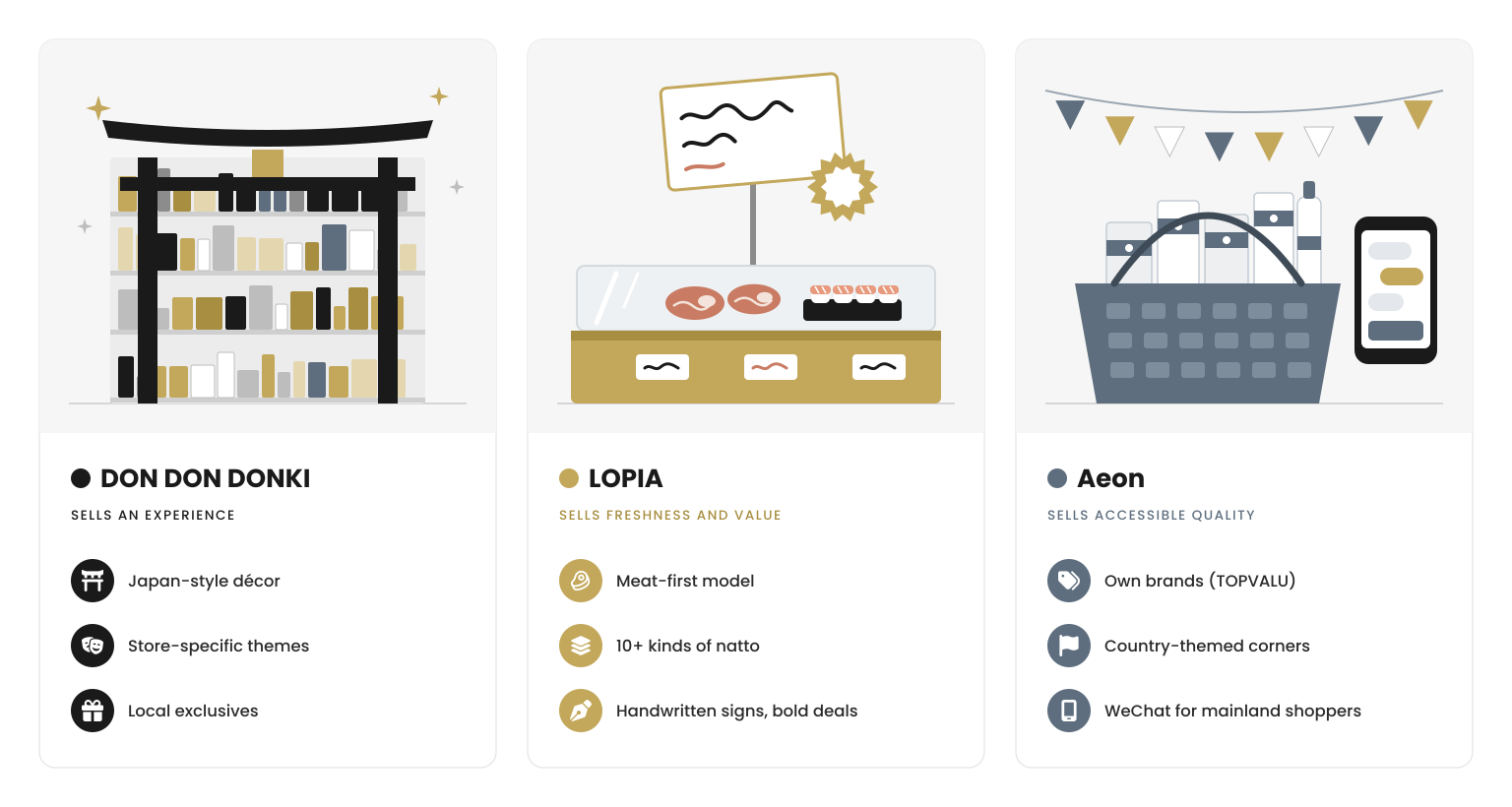
DON DON DONKI sells an experience. The stores are built for browsing, and local touches are mostly about atmosphere and novelty. Its first Taiwanese store launched with Japanese apples and live shellfish as exclusive services; the second, in Taipei, was decorated with torii gates, masks and daruma dolls, with a checkout area styled after Tokyo’s Yamanote line. In Singapore, stores have their own themes, from aviation at Jewel Changi, which also has a halal corner, to a safari at Northpoint and an arcade at Jurong Point. In Macao, the chain launched with products sold nowhere else, including instant noodles and crisps developed with Nissin.
LOPIA sells freshness and value, with a lot of theatre. Meat is the company’s DNA: in Japan it accounts for around 30% of revenue and 80% of profit. Uni-President’s chairman summed up the model as few categories, but a very deep range within each. In Taiwan, LOPIA positions itself as a “food theme park”. Store managers set their own prices and displays, and the range goes deep enough to carry more than ten kinds of natto, against two or three in a typical local supermarket. Its Taiwanese social media accounts write in Taiwanese and lean on Taiwan-Japan friendship, and its Japanese general manager spent months answering customers personally on Threads, in Chinese. In store, handwritten signs and dense displays encourage impulse buying, and openings come with eye-catching offers such as buy-one-get-one-free wagyu and NT$20 salmon sushi.
Aeon sells accessible quality, through its own brands. In Malaysia, the company wants to stand out with products nobody else sells: TOPVALU accounted for 5 to 6% of its food sales in 2024, with a target of 20%. It also hosts country-themed operations. In 2024, AEON Malaysia stores ran a TAIWAN SELECT promotion with around 160 products from 45 Taiwanese companies, highlighting halal-certified items to reach Malay shoppers. In Hong Kong, Aeon launched a WeChat mini programme in 2025 to attract shoppers from mainland China.
What shoppers want
Consumers in the region still want indulgence, but less sweet, closer to local tastes, and with a texture worth paying for.
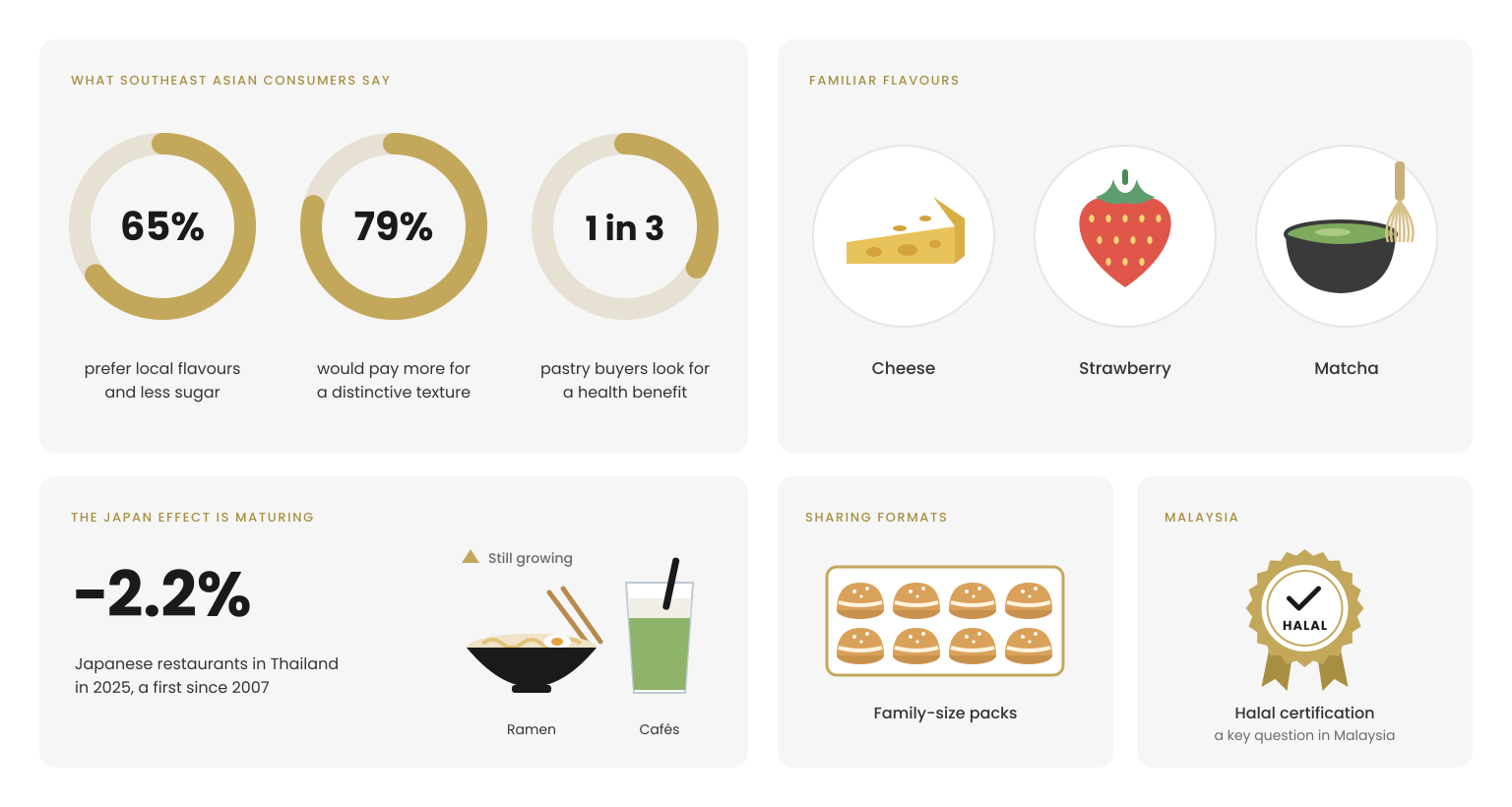
Less sugar, more local flavour. According to Cargill’s research on indulgence in Southeast Asia, 65% of consumers prefer local flavours and lower sugar in their desserts, and 69% say health attributes matter, with low sugar the most influential. Two-thirds care about country of origin, but 65% are also willing to pay more for local Asian ingredients. The same study found that 79% would pay a premium for a distinctive texture, and that one pastry consumer in three looks for a health benefit such as less sugar, less fat or a shorter ingredient list. This echoes what we saw in our macaron article: recipes that work in Asia are rarely the catalogue version.
The appetite for Japan is maturing. In Thailand, the number of Japanese restaurants fell by 2.2% in 2025 to 5,781, the first decline since JETRO began its survey in 2007. The only segments still growing were ramen and cafés, while matcha, Japanese desserts and café culture remain visible parts of Japan’s appeal in Thailand. On its own, a Japanese label may no longer be enough to stand out.
Cheese, strawberry and matcha are familiar territory. At Don Quijote’s 2025 Hit Product Awards in Japan, BAKE’s Creamy Cheese baked chocolates ranked first among bulk purchases by overseas visitors, and were a top seller with visitors from five of the seven Asian countries surveyed. LOPIA’s best-known dessert in Taiwan is a cheesecake, and its strawberry desserts crossed from Thailand to Taiwan.
Sharing formats have a market. Costco Taiwan sells frozen desserts such as cream puffs, tiramisu and taiyaki in large packs designed for gatherings, a useful benchmark for European suppliers considering family-size retail formats.
Halal is a key question in Malaysia. For products sold as halal in Malaysia, imports must meet Malaysian halal requirements or be certified by a foreign halal body recognised by JAKIM, Malaysia’s Islamic development department, which recognised 84 such bodies in 46 countries in 2022. Halal also matters commercially: AEON Malaysia highlighted halal-certified items in its TAIWAN SELECT promotion to reach Malay shoppers. For desserts containing gelatine or other animal-derived ingredients, the status needs to be checked product by product before any listing discussion.
What this means for European frozen dessert producers
These chains are worth the effort, but not all in the same way, and not with the same product.
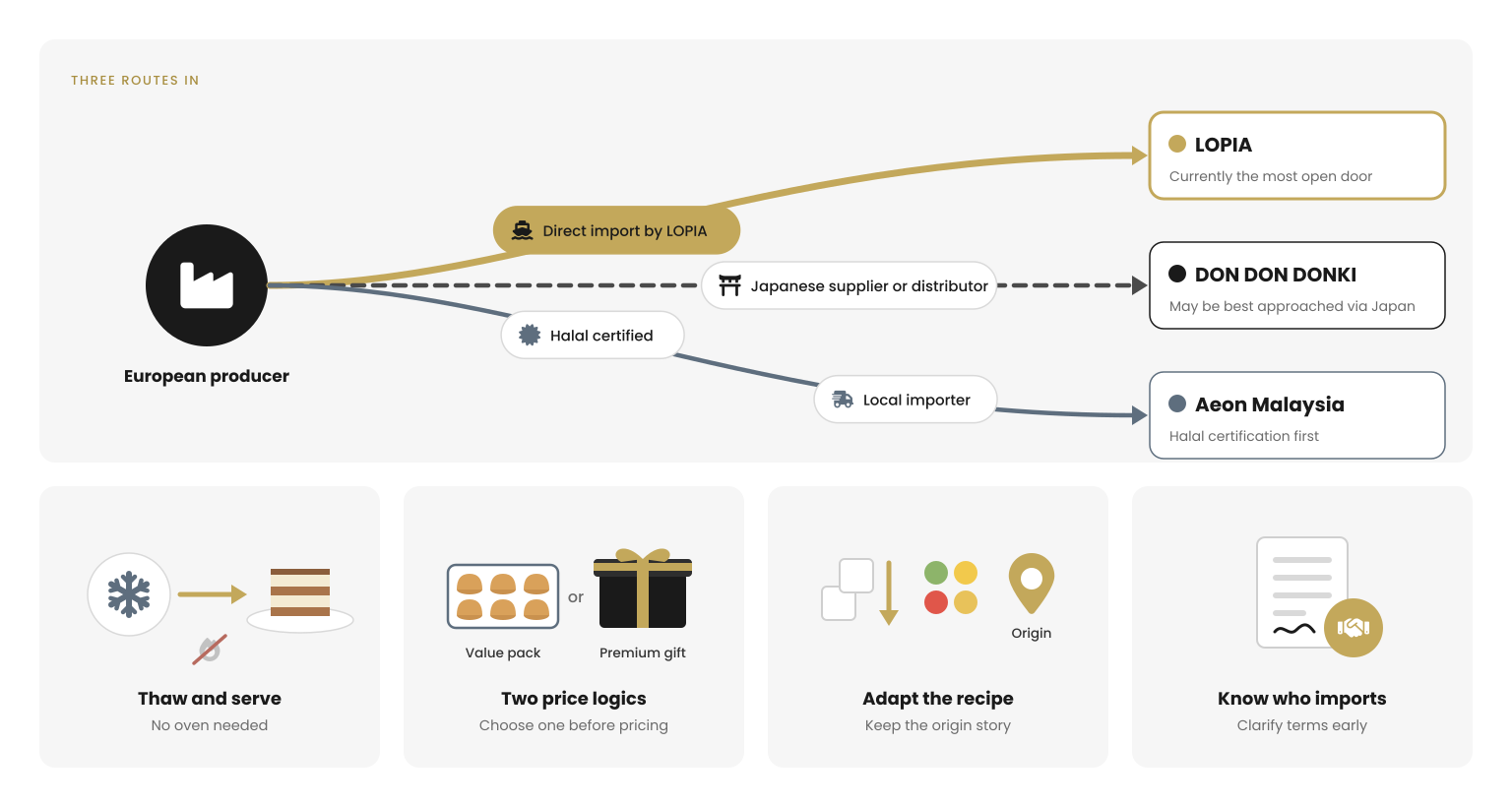
- LOPIA currently looks like the most open door. It already sells an imported Italian tiramisu as one of its best-known desserts, and its PREMIO format was announced with room for frozen desserts imported from Europe. With LOPIA keeping a majority of the import and manufacturing company after the Uni-President deal, it should retain a strong say over sourcing, although post-deal decision-making remains to be seen.
- Don Quijote may be best approached through Japan. Buying is largely centralised there and the concept is built on Japanese products, so the most realistic routes may be European recipes produced or distributed in Japan, or products carried by the group’s existing Japanese suppliers. The crème brûlée and Basque cake show that European formats are already familiar to its shoppers.
- Aeon Malaysia rewards preparation. Halal certification is likely to be the first question. Country-themed operations such as TAIWAN SELECT also show a format that a group of European producers, or a national trade body, could build on.
- Thaw-and-serve fits what is on the shelf. Every popular example we found, from tiramisu and cheesecake to parfaits and mochi ice cream, is eaten without an oven, so tiramisu, cheesecakes, entremets and desserts in glasses are a natural fit for these chains.
- Two price logics coexist. One is the large, shareable value product, the NT$333 tiramisu or a Costco pack. The other is the premium or gift item that formats like LOPIA PREMIO are built for. It pays to decide which one a product is before setting a price.
- Adapt the recipe, not the identity. Consumer research points to demand for local flavours, lower sugar and distinctive textures, so European suppliers should be ready to adapt recipes while keeping a clear origin story, which is what makes the product worth importing in the first place.
- Know who imports, and who decides. Each chain buys differently: direct import for LOPIA, centralised buying in Japan for Don Quijote and, for many retailers in the region, a local importer. Clarifying the importer of record and the commercial terms early, including payment terms, saves time later.
Japanese chains will not become the main route to market for every European dessert. But they are worth watching closely: they have taught a large number of Asian shoppers to buy imported food, and at least one of them has announced European frozen desserts for its upmarket format.
At Gourmet Selection, with offices in Taipei, Tokyo and Shenzhen, we work every day between European producers and Asian buyers, and this kind of market reading is part of that work. If you make frozen desserts or pastries and are wondering how they would fit in Taiwan, Hong Kong, Thailand, Malaysia or Singapore, we would be glad to talk it through.
Sources
AEON Stores (Hong Kong) Co., Limited. (2025, August 28). AEON Stores announces 2025 interim results. https://www.aeonstores.com.hk/new/detail?id=653
AEON Stores (Hong Kong) Co., Limited. (2026, March 27). 2025 annual results announcement. https://www2.cre8ir.com/static/pdf/00984/202603/2026032700838.pdf
AEON is ‘different’ when goods are same across market. (2024, October 13). Business Today. https://www.businesstoday.com.my/2024/10/13/aeon-is-different-when-goods-are-same-across-market/
AEON exits Thailand’s supermarket business, focuses on Vietnam. (2026, August 10). Vietstock. https://en.vietstock.vn/2026/08/aeon-exits-thailands-supermarket-business-focuses-on-vietnam-974-640698.htm
AEON Group celebrates 37 years in Malaysia. (2021, October). New Straits Times. https://nst.com.my/amp/news/nation/2021/10/737041/aeon-group-celebrates-37-years-malaysia
Aeon plans to open new store near Mitec by end-2025. (2024, February 24). Bernama. https://www.bernama.com/en/news.php?id=2273161
AEON to unveil maiden AEON STYLE Supermarket to deliver modern, convenient shopping experience. (2025, November 25). Focus Malaysia. https://focusmalaysia.my/?p=226789
AP abolishment: Entry of halal food subject to Trade Descriptions, says Jakim. (2022, June 12). Malay Mail. https://www.malaymail.com/news/malaysia/2022/06/12/ap-abolishment-entry-of-halal-food-subject-to-trade-descriptions-says-jakim/11941
Don Don Donki outlets in Singapore. TheSmartLocal. https://thesmartlocal.com/read/don-don-donki-singapore-outlets/
Don Don Donki has new strawberry cream cheese mochi sandwiches. (2022, July 14). Eatbook. https://eatbook.sg/?p=109967
Don Don Donki store to open in Taipei’s Ximending shopping area in 2 weeks. (2021, January 5). Taiwan News. https://www.taiwannews.com.tw/en/news/4095329
Don Quijote PR team reveals! Best-selling items in 7 Asian countries. FUN! JAPAN. https://www.fun-japan.jp/en/articles/14235
Japanese department chain store debuts. (2021, September 10). Macau Daily Times. https://macaudailytimes.com.mo/?p=146090
Japanese parfait desserts spotted at Don Don Donki, with choco mint and strawberry cheesecake flavours. (2021, October 28). Eatbook. https://eatbook.sg/parfait-desserts-singapore
Japan’s LOPIA opens first Thailand store at Central Chaengwattana. (2026, February 12). Khaosod English. https://www.khaosodenglish.com/tech/2026/02/12/japans-lopia-opens-first-thailand-store-at-central-chaengwattana/
Less sugar, more sweets: Asians seek local flavours in healthier treats. (2025, September 17). FoodNavigator-Asia. https://www.foodnavigator-asia.com/Article/2025/09/17/asians-seek-local-flavours-in-healthier-treats
Nutella ice cream exists & you can apparently get it at AEON? SAYS. https://says.com/my/eats/nutella-ice-cream-exists-you-can-apparently-get-it-at-aeon
Pan Pacific International Holdings. (2019). Integrated report 2019. https://ppih.co.jp/en/ir/pdf/ar_2019_12.pdf
Pan Pacific International Holdings. (2025, November 12). Overview of Q&A session at analysts briefing for Q1 FY6/26. https://ppih.co.jp/en/ir/library/earnings/pdf/PPIH_FY2026_Q1_QA_E.pdf
Pan Pacific International Holdings. Group store network (store counts as of 20 September 2026). https://ppih.co.jp/en/search/
Pan Pacific International Holdings. Overseas retail operations. https://ppih.co.jp/en/social/overseas/
Southeast Asians crave taste in new indulgence era, says Cargill Indulgence Study. (2025, June 25). Cargill. https://www.cargill.com/2025/southeast-asians-crave-taste-in-new-indulgence-era
TAIWAN SELECT, AEON collaboration brings Taiwanese food to Malaysian consumers. (2024, November 22). Bernama. https://web11.bernama.com/en/news.php?id=2366478
Thailand’s Japanese restaurant market hits maturity as numbers dip. (2026). The Nation. https://www.nationthailand.com/news/general/40061480
Tops absorbs MaxValu as Central Retail expands. (2026). The Thaiger. https://thethaiger.com/news/business/central-retail-snaps-up-30-maxvalu-branches
Why Aeon gave up on Thai supermarkets. (2026, August). Inside Retail. https://insideretail.com.au/business/why-aeon-gave-up-on-thai-supermarkets-202608
「從門可羅雀到全台爆紅」日超LOPIA為何登台2年大逆轉?(2025). 世界日報. https://www.worldjournal.com/wj/story/121221/9180920
【Threads上紅什麼】日系超市LOPIA必買美食TOP 6!提拉米蘇、函館布丁、和牛燒肉不踩雷. (2026, January 6). Marie Claire 美麗佳人. https://www.marieclaire.com.tw/lifestyle/taste/90928
【下班經濟學】好市多危險了?這間「超市黑馬」太狠!開幕營收破億神話. (2026, May 21). 風傳媒. https://www.storm.mg/article/11133592
DONKI擴張過快 亞洲每店盈利大跌 產品與需求脫節 社長冀一年內重整業務. (2024, April 7). 星島頭條. https://www.stheadline.com/realtime-finance/3332848/
LOPIA 台南三井 Outlet 店開幕優惠必買商品!(2026, March 16). 上報. https://www.upmedia.mg/tw/lifestyle/food/254000
LOPIA 獲統一超 20 億成立合資公司,總經理親揭策略合作原由. (2026, May 1). TechNews 科技新報. https://finance.technews.tw/2026/05/01/pcsc-and-oic-group/
LOPIA超市必買人氣排名 搶購日本直送黑毛和牛、起司蛋糕與栃木草莓. (2026, February 10). 蕃新聞. https://n.yam.com/Article/20260210820946
全台|DON DON DONKI 11月巧克力甜點大賞啟動!精選超過20項巧克力與甜點. (2024). 輕旅行. https://travel.yam.com/article/136012
全聯壓力再升級!統一入主台灣LOPIA,「對手成親家」背後各自盤算為何?(2026, April 30). 數位時代. https://www.bnext.com.tw/article/90821/uni-president-invests-in-taiwan-lopia
冷凍甜點/冰淇淋. Costco 臺灣. https://www.costco.com.tw/Food-Dining/Frozen-Fresh-Food/Frozen-Desserts-Ice-Cream/c/90805
唐吉訶德進駐高雄!開全台最大千坪旗艦店,主打特色壽司、日本生鮮專區. (2022). 數位時代. https://www.bnext.com.tw/article/67270/don-don-donki-store-two
家樂福改名倒數,羅智先:7 月起停用舊名稱. (2026, May 20). TechNews 科技新報. https://finance.technews.tw/2026/05/20/tw-carrefour-to-retire-old-branding-starting-in-july/
為漢神百貨量身打造精品超市 LOPIA PREMIO全球首店Q3開幕. (2026, March 6). 工商時報. https://www.ctee.com.tw/news/20260306700733-431401
統一超20.54億入股LOPIA!一筆投資拆兩家、51%對49%,雙方各取通路與商品主導權. (2026, May 4). 數位時代. https://www.bnext.com.tw/article/90820/uni-president-lopia-taiwan-strategic-partnership-2026
確定了!又一家新光三越將開 LOPIA 超市 預計7月登場. (2026). 聯合新聞網. https://udn.com/news/story/7241/9500108
開箱/奢華版「LOPIA PREMIO」全球首店落腳高雄 亮點與開幕優惠一次看. (2026, September 12). TVBS新聞網. https://news.tvbs.com.tw/life/4021204
DON DON DONKI summer campaign for Japanese ice creams and desserts (in Chinese). 食力 foodNEXT. https://www.foodnext.net/life/recipes/dessert/paper/5111829317
2025年度タイの日本食レストランは5,781店舗 調査開始以来で初の減少. (2026, January 20). JETRO Bangkok. https://www.jetro.go.jp/ext_images/thailand/food/2025survey/20260120press.pdf
株式会社ロピア (LOPIA). 店舗情報 (store list as of October 2026). https://lopia.jp/shops/#area-taiwan


